Jumat, 31 Juli 2015

Weekend Roundup

  • "Donald Trump’s lawyer was right: In some places, raping your wife is still treated like a minor offense" -- so says legal historian Jill Hasday (University of Minnesota) in an op-ed in the Washington Post.
  •  The John Jay College of Criminal Justice will hold its Law and Literature Conference from October 30 to November 1, 2015. This year's conference "will explore the way that literary renderings of labor concerns, broadly defined, have responded to or have influenced the law." (Hat tip: Legal Scholarship Blog)
  • From History News Network: Medievalist Gillian Pollack reminds us that the Magna Carta was "not the first written document of its kind" and historian Corey Brooks (York College) weighs in on the drive to remove the Maryland State House's monument to former Supreme Court Justice Roger Taney.
  • At In Custodia Legis, the spotlight is on Civil Law systems. Foreign law specialist Eduardo Soares highlights resources from the Library of Congress's collection.
  • The website MLive’s appreciation of the late David Edward Kyvig is here.
  • The Faculty Lounge is hosting a blog symposium on Harper Lee's Go Set a Watchman. A post by historian Matthew Crow (Hobart and William Smith College) is here.
Weekend Roundup is a weekly feature compiled by all the Legal History bloggers.

Oliveri, "Setting the Stage for Ferguson: Housing Discrimination and Segregation in St. Louis"

Rigel Christine Oliveri (University of Missouri School of Law) has posted "Setting the Stage for Ferguson: Housing Discrimination and Segregation in St. Louis," which is forthcoming in the Missouri Law Review. Here's the abstract:
The events of fall 2014 in Ferguson, MO (the shooting death of Michael Brown by a white police officer and the subsequent protests and riots), have been examined from many angles – the policing of minority communities, the militarized police response to peaceful protests, the poor schools and job prospects for young people like Mr. Brown, etc… This paper adds another factor to the analysis: housing discrimination.

St. Louis is one of the most segregated places in the country and this is not an accident. The history of St. Louis is replete with discriminatory housing laws, policies, and practices. While these were common throughout the United States, they were particularly egregious, widespread, and pervasive in industrial mid-western cities like St. Louis. St. Louis, in fact, was where three of fair housing law’s most foundational fair housing cases emerged from: Shelly v. Kraemer, which held that racially restrictive covenants could not be enforced by courts; Jones v. Mayer, which held that private acts of race discrimination in housing were prohibited by the Civil Rights Act; and United States v. City of Black Jack, which recognized the use of disparate impact theory in fair housing cases. When we look closely at these cases – not just the legal principles that they established but the physical, racial geography of the homes, neighborhoods, and cities that were contested – we can see how they reflected the racist forces that shaped the reality of modern metropolitan St. Louis.

This paper traces the history of housing discrimination in the St. Louis metro area using these cases as a framework, concluding with a discussion of how these historical forces resonate in contemporary Ferguson. The paper concludes with suggestions for reforms that might help undo what a century’s worth of officially sanctioned discrimination and segregation have wrought.
Hat tip: Poverty Law

Welcome, Mary Ziegler!

We’re very pleased to announce that Mary Ziegler, the Stearns Weaver Miller Professor at the Florida State University College of Law, will be guest blogging with us for the month of August.  The occasion is her recent publication of After Roe: The Lost History of the Abortion Debate (Harvard University Press).  Welcome, Mary!

How Materiality Shapes the Law: From Manuscripts to Digitization

[We have the following announcement.]

How Materiality Shapes the Law: from Manuscripts to Digitization

August 27, 2015 at Berkeley Law

Public Reception: 4:00–4:30pm 295 Boalt Hall (Warren Room)

Public Panel Event: 4:30–6:00pm 170 Boalt Hall (Koret Room)

Gero Dolezalek (Aberdeen) Why Did Early Modern Scots Hand-Write Legal Literature Instead of Printing It?

Paul Halliday (University of Virginia) Precedents Are Things: Clerical Authority and the Judge’s Voice in the Eighteenth Century

Robert Berring, Jr. (Boalt) Rethinking Legal Authority in the Digital Age

(Gero Dolezalek will teach a legal paleography workshop on August 28, 2015.)

Contact: RBS-Mellon Fellow and Robbins Collection Associate Research Fellow, Lena Salaymeh (lenas@berkeley.edu).  Please RSVP here if you plan to attend.

Kamis, 30 Juli 2015

Clyde Tombaugh's Vision of Mars (1959)

Elysium and Tombaugh crater are located near the center of this image from India's Mars Orbiter spacecraft.
Image credit: Indian Space Research Organization
Clyde William Tombaugh (1906-1997) was born in Streator, Illinois, and grew up in Burdett, Kansas, where he built his first telescopes. In 1929, Tombaugh joined the staff of Lowell Observatory in Flagstaff, Arizona, to hunt for Planet X, a world which Boston businessman Percival Lowell had predicted should exist beyond Neptune. On 18 February 1930, 24-year-old Tombaugh discovered Pluto.

A little over two weeks ago, on 14 July 2015, the New Horizons spacecraft raced through the Pluto system. The piano-sized probe bore some of Tombaugh's ashes. The New Horizons scientists applied the unofficial name Tombaugh Regio to a prominent surface feature on Pluto.

It is possible that Tombaugh Regio will not win through the formal planetary feature naming process, in part because a feature named for Tombaugh already exists: a crater on Mars, the world to which he devoted far more professional attention than he did Pluto. Tombaugh crater is located at 162° East, just north of the martian equator in Elysium Planitia, a region that Tombaugh believed was important for understanding the surface structure of the Red Planet.

Clyde Tombaugh with a telescope of his own making. Image credit: Wikipedia
Although Pluto became Lowell Observatory's greatest claim to fame, Percival Lowell had founded his observatory in 1894 to find proof of intelligent life on Mars. He had theorized that the aging planet was slowly losing its water, and that the dark lines some astronomers glimpsed on its ochre disk were canals its inhabitants had excavated to distribute melt water from the polar ice caps and stave off encroaching deserts.

Lowell believed that spots strung like beads along the lines were oases, and that irregular dark-colored areas (maria) scattered over the surface were desiccated sea beds. Though rejected by most astronomers (including Tombaugh), Lowell's romantic vision helped to inspire H. G. Wells' novel The War of the Worlds (1898) and the "Barsoom" books of Edgar Rice Burroughs. These tales in turn inspired generations of rocketeers and skywatchers.

In the January 1959 issue of Astronautics, the journal of the American Rocket Society, Tombaugh summarized the prevailing view of Mars surface conditions on the eve of its exploration by spacecraft. He first described three areas where improved data had undermined Lowell's romantic vision.

The first was temperature. Depending on its position in its elliptical orbit around the Sun, Mars receives between 53% and 36% as much solar energy as Earth. Astronomers using telescopes equipped with thermocouples had determined that the temperature on the surface at noon normally barely surpassed the freezing point of water, though it could reach 70° Fahrenheit at noon in the southern hemisphere in summer. Tombaugh added that the temperature regularly swings 200° Fahrenheit from frigid midnight to chilly noon over much of the planet.

Low atmospheric pressure also created problems for Lowell's Mars. Evidence was mounting, Tombaugh wrote, that at its surface Mars had an atmospheric pressure only 10% as great as Earth's sea-level pressure. Enough carbon dioxide was known to exist in the martian atmosphere to give the planet an atmospheric pressure about 1% of Earth's. Many planetary astronomers, Tombaugh added, believed that nitrogen made up the remaining nine-tenths of the martian atmosphere, though none had been detected.

Finally, Mars' surface was likely to be subjected to unhealthy levels of radiation. Planetary astronomers had found no evidence of oxygen in the martian atmosphere, Tombaugh reported. Whatever oxygen Mars had was probably locked up chemically in its crust, giving the planet its characteristic rusty color. Lack of free oxygen meant that Mars would also lack atmospheric ozone, which on Earth creates a shield against solar ultraviolet (UV) radiation. This meant that sterilizing UV radiation from the Sun would reach Mars's surface largely unfiltered.

Tombaugh argued that the dark maria could not be sea bottoms; they would be salt-encrusted if they were, so would appear bright white, not dark. Mars, he added, showed no signs of "a visible dendritic [branching] drainage system" akin to Earth's rivers, so was probably extremely arid. He noted seasonal changes in the maria's color which he attributed to plant life. As the polar cap evaporated in springtime, he wrote, atmospheric moisture would move toward the equator. The martian vegetation in the spring/summer hemisphere would absorb the moisture and change hue.

Tombaugh contended that martian plants had evolved novel ways of withstanding the planet’s cruel conditions. He recounted telescopic observations he made during Mars' close approach to Earth in 1954.
Normally the southern maria range from green to blue in color. The long dark sash, Sabaeus Sinus, running east to west only a few degrees south of the equator, is habitually bluish-green. Amazingly . . . this marking . . . altogether some 2000 miles long . . . suddenly turned to bright lavender or perhaps magenta! The other maria did not. Why? Can vegetation inhabiting this area shield itself by changing pigment to reflect away a sudden influx of lethal radiation?
Sometimes, Tombaugh reported, Mars' cruel conditions could spell catastrophe for even the toughest martian vegetation. He wrote that Syrtis Major,
the principal dark marking on Mars, undergoes some very strange metamorphoses in color. The north half is habitually of a deep blue color, while the southern half is grey-green to blue-green or sometimes a vivid green. I remember . . . when the whole marking became intensely black – totally devoid of color! In the absence of oxygen, dead vegetal matter would not yield to oxidation and decay. Were we seeing dead vegetal matter when the Syrtis turned black?
Tombaugh assured Astronautics readers that he did not believe in Lowell's intelligent Martians, though he hastened to add that he had "seen over 100 of the controversial canals too well, with telescopes of great effective power" to be able to "dismiss them as unreal." He offered an explanation for the planet's linear features that was first advanced by former Lowell collaborator William Pickering in 1904.
Over the ages, Mars must have been hit by many asteroids. Such dreadful collisions must have produced some visible marks . . .  Collisions with asteroids a few miles in diameter going at velocities of the order of 15 [miles per second] might well fracture a planet to the bottom of the crust and to radial distances of hundreds or even a few thousand miles . . . Where a fracture line met the surface, a long narrow strip of shattered rock would be produced, and would offer some haven to a hardy form of vegetation . . . [The plants growing in the fracture strip would] make a dark contrast against a light . . . terrain.
Tombaugh theorized that the dark spots Lowell thought were oases are actually asteroid impact craters. The canals, he asserted, divided the planet's entire crust into a "tetrahedron" pattern. As Mars cooled internally and shrank, some faces of the martian tetrahedron slumped. Tombaugh differed from the majority opinion of his time when he argued that other faces had risen to form high plateaus. Many of his contemporaries confidently asserted that Mars lacked any raised landforms. The northern-hemisphere region of Elysium, Tombaugh added, was probably the highest land on the planet. He explained that it
is sharply pentagonal in shape, [and] bounded by five long canals . . . The corners of the pentagon extend 600 geographical miles from the center. During most of the Martian year, Elysium appears much the same as the surrounding desert. By midsummer of the northern hemisphere, this area becomes white with frost except around noon . . . the whitening develops over the entire area, but always stops abruptly at the edges of the pentagon. One is forced to conclude that the five sides represent enormous vertical escarpments - and just where we should expect to see them - along the canals.
After five decades of Mars exploration by robot spacecraft - the first was Mariner IV, which flew past the planet on 14 July 1965, 50 years to the day before the New Horizons Pluto flyby - we know that Elysium is indeed an uplifted region, though not the highest on Mars. That honor goes to the massive Tharsis Plateau, upon which stand the planet's great shield volcanoes. The tallest of these, Olympus Mons, stands some 27 kilometers above the base datum, the martian equivalent of Earth's sea level.

Topographic map of eastern Elysium Planitia showing Tombaugh crater. The image is based on data from the Mars Orbiter Laser Altimeter (MOLA) carried on the Mars Global Surveyor spacecraft. Low areas are blue and high areas are yellow and red. Image credit: MOLA Science Team/NASA
We know today that, when Tombaugh's contemporaries detected martian atmospheric carbon dioxide, they had found not a minor atmospheric constituent, but instead virtually Mars' entire atmosphere. We have learned that branching channels are common on Mars, though at a scale invisible to Earth-based telescopes, and that Lowell's canals were products of eyestrain, the mind's tendency to impose patterns on random arrangements of objects, and wishful thinking.

We know also that the dark areas on Mars are mostly sand made of volcanic rocks, and that seasonal changes in their color and extent result from obscuring dust storms. We have found cracks in the martian crust, though those associated with asteroid impact craters are only local in extent. The best-known crustal fracture, the 3000-mile-long Valles Marineris canyon system, probably formed through internal stresses associated with the uplift of Tharsis. We know that the planet's overall shape has a pattern, though not one as intricate as Tombaugh's tetrahedron. Rather, Mars has southern highlands and northern lowlands (the latter at least partly underlain by ice, lending credence to the theory that it is an ancient ocean bottom).

In spite of our improved knowledge, key questions about Mars remain unanswered. We do not know, for example, whether it hosts living organisms. The pitch for piloted Mars exploration which concluded Tombaugh's paper thus remains relevant today.
[W]hy should we be interested in making a trip to Mars? . . . A manned landing on Mars would be a momentous achievement for the human race. It would be a field day for the geologist, biologist, astrophysicist, and meteorologist. They would glean knowledge on the consequences of a set of physical conditions foreign to us . . . Most important, to see at first hand what Nature has done with a world so marginal for life would be of the greatest philosophic and religious value, in helping us to understand our place and our purpose in the Universe.
Astronauts seek signs of past life on Mars. Image credit: NASA/Pat Rawlings
Sources

“Mars – A World for Exploration,” Clyde W. Tombaugh, Astronautics, January 1959, pp. 30-31, 86-93.

Mars and Its Canals, Percival Lowell, The MacMillan Company, 1906.

Related Post

Pluto, Doorway to the Stars (1962)

Wyzanski Speaks!

Wyzanski, 1937 (LC)
Back in 2011, I mentioned that although the recording of Paul Freund's contribution to the Stanley Reed Oral History Project of the Louie B Nunn Center for Oral History of the University of Kentucky Libraries was available online, Charles E. Wyzanski, Jr.'s was not.  Well, Wyzanski's is now, along with those of twenty-one other contributors. Anyone interested in the constitutional history of the New Deal will want to give it a listen.  It covers far less terrain than Wyzanski's oral history at Columbia University, but nothing beats the spoken word, at least when Wyzanski is the speaker!  (Apologies in advance to Stanley Reed fans.)

Rabu, 29 Juli 2015

CFP: Constitutional History: Comparative Perspectives

[We have the follow call for papers.]

Paper proposals are invited for the Second Annual Illinois-Bologna conference on Constitutional History: Comparative Perspectives. The conference will be held in Chicago, Illinois, on April 12 & 13, 2016. The conference keynote speaker will be Justice Rosalie Silberman Abella of the Supreme Court of Canada. 

Accompanying the spread of constitutional government around the world has been a profound interest in the comparative aspects of constitutional law. Scholars have catalogued the differing features of national constitutions and examined how different constitutional systems resolve common legal issues. So, too, judges faced with legal questions have sought guidance in the decisions of constitutional courts of other nations. While comparative constitutional law is therefore a well-established field, less attention has been paid so far to the comparative dimensions of constitutional history. This international conference aims to address that shortcoming by energizing the study and analysis of constitutional history from comparative perspectives. The conference has several interrelated goals. It will provide a forum for presentation and discussion of current research on issues of constitutional history that crosses national boundaries. Relevant topics in this regard include such things as the origins of constitutional governments in different nations, changes in constitutional structures over time, comparative studies of the shifting roles of constitutional actors, the development of individual rights in different systems, and the legitimacy and longevity of constitutions in various nations. The conference will also bring together scholars who, at present, are working on constitutional histories of single jurisdictions—with the expectation that conversations among these scholars will allow for sharing of methodologies and point also to fresh areas of research that may transcend national boundaries. In addition, the conference has relevance to the task of judging. In some nations, notably the United States, constitutional history plays an important and sometimes decisive role in the resolution by courts of questions of constitutional law. The conference will take up the place of constitutional history in constitutional adjudication. By comparing the practices of courts around the world, the conference will trace the movement (or not) of constitutional history from the academy to the courthouse and examine the risks and benefits of modern practices.

Scholars interested in presenting a paper at the conference should e-mail a title and summary of the proposed paper along with a CV to Professor Jason Mazzone at mazzonej[@]illinois.edu. Proposals received by November 1, 2015 will receive priority. After that date, submitted proposals will be considered only if space remains.

Papers from the conference will be published in the University of Illinois Law Review. Conference participants are responsible for their own travel and accommodation expenses.  Sponsored by: University of Illinois College of Law, University of Bologna School of Law, Center for Constitutional Studies and Democratic Development, University of Illinois Law Review

Selasa, 28 Juli 2015

Tyler on Habeas and the American Revolution

Amanda L. Tyler, University of California, Berkeley School of Law, has posted Habeas Corpus and the American Revolution, which is forthcoming in the California Law Review 103 (2015): 635-98.
Modern debates concerning the protections afforded by the Suspension Clause of the U.S. Constitution have taken place within the Supreme Court’s chosen methodological approach in this context, which openly calls for careful attention to the historical backdrop against which the Clause was drafted. This approach is hardly surprising given that long ago Chief Justice John Marshall declared that when the Founding generation constitutionalized “this great writ,” they invoked “[t]he term...in the [C]onstitution, as one which was well understood.” No matter how well the Founding generation understood the content, reach, and application of the “privilege of the writ of habeas corpus,” however, significant portions of the relevant historical backdrop to the ratification of the Suspension Clause remain lost to the annals of history. In particular, the details surrounding one of the most consequential periods in the history leading up to the adoption of the Suspension Clause — namely, the treatment and legal classification of the American colonists by the British during the American Revolutionary War — remain largely unexplored in legal scholarship.

Professor Tyler seeks to recover and tell this story here by drawing upon a wealth of sources, including: archival documents, parliamentary debates, contemporary press accounts, colonial papers, diaries and private papers of key participants, and significant decisions and rulings of the British courts. As these materials reveal, determinations regarding the reach and application of the English Habeas Corpus Act of 1679, rather than solely the common law writ of habeas corpus, were of tremendous consequence during this important period in Anglo-American legal history. Where the Act was in force and where prisoners could claim its protections, the legal framework demanded that such persons be charged criminally and tried in due course or otherwise be discharged. Significantly, the privilege associated with the English Act did not speak merely to process; it further imposed significant substantive constraints on what causes would be deemed legal justification for detention in the first instance. The important role that the Act played in the Revolutionary War legal framework, moreover, suggests that modern jurisprudence has underappreciated the Act’s enormous influence upon the development of habeas law in the Anglo-American tradition. Finally, the history recovered here demonstrates more generally that during the Revolutionary War, suspension, geography, and allegiance each played significant roles in determining the availability of the privilege of the writ of habeas corpus to those who would claim its protections.

Dudziak Named Kluge Chair in American Law and Governance

[We’re delighted to report that LHB Founder Mary L. Dudziak will be the Kluge Chair in American Law and Governance at the Library of Congress.  Here is the LC press release.]

Librarian of Congress James H. Billington today announced the appointment of Mary L. Dudziak, prominent U.S. legal historian, as the next Kluge Chair in American Law and Governance at the Library’s John W. Kluge Center.  Her appointment begins August 1. She will spend five months in residence.

Dudziak is the Asa Griggs Candler Professor of Law and director of the Project on War and Security in Law, Culture and Society at Emory University.  An expert in constitutional law, legal history, diplomatic history and civil rights history, Dudziak will use the Library’s collections and resources to research and write her forthcoming book, “Going to War: An American History.”

“The book is an effort to get to the roots of an important problem: the relative absence of political engagement with presidential war power in an era of ongoing war,” said Dudziak. “American military engagement has been persistent through the 21st century, but as time goes on Congress has appeared reluctant to formally authorize war and the American public has been somewhat disengaged from the conflicts. This has left the president without meaningful political limits on the power to go to war. To better understand how this contemporary problem came about, my book will examine the history of American war politics since the early 20th century, focusing not only on lawmakers but also the way their constituents —civilians as well as military-service members—experienced American wars.”

Dudziak will use items in the Library of Congress collections to further her research. In particular, she will examine Congressional papers held by the Library’s Manuscript Division. Toward the end of her tenure, Dudziak will deliver a public lecture on her research.

Prior to her position at Emory, Dudziak was the Judge Edward J. and Ruey L. Guirado Professor of Law, History and Political Science at the University of Southern California.  She also taught at Duke, Harvard, the University of Maryland and the University of Iowa.  Dudziak serves on the Historical Advisory Committee for the U.S. Department of State and the editorial board of the journal Diplomatic History.

Her books include “War-Time: An Idea, Its History, Its Consequences,” “Exporting American Dreams: Thurgood Marshall’s African Journey,” “Cold War Civil Rights: Race and the Image of American Democracy” and edited collections.  She is the author of numerous book chapters, journal articles, essays, reviews and op-eds.  Dudziak received her Ph.D. from Yale University, her J.D. from Yale Law School, and her A.B. in sociology from University of California, Berkeley.

The Kluge Chair in American Law and Governance is a distinguished senior research position in residence at the Library.  Its holder is appointed by the Librarian of Congress.  Using research facilities and services at the Library of Congress, the scholar conducts research that focuses on the development of government in the United States and on domestic matters of, and among, the three branches of government.

Through a generous endowment from John W. Kluge, the Library of Congress established the Kluge Center in 2000 to bring together the world's best thinkers to stimulate and energize one another, to distill wisdom from the Library's rich resources, and to interact with policymakers in Washington. For more information about the Kluge Center visit here.

Senin, 27 Juli 2015

Brophy on Antislavery Women and the American Jurisprudence

Alfred L. Brophy, University of North Carolina School of Law, has posted Antislavery Women and the Origins of American Jurisprudence, which is forthcoming in the Texas Law Review.
“Antislavery Women and the Origins of American Jurisprudence" is an essay review of Sarah Roth's Gender and Race in Antebellum Popular Culture (Cambridge University Press, 2014). It assesses Roth's account of the dialog between antislavery and proslavery writers. Roth finds that the antislavery and proslavery writers were joined in their depiction of enslaved people in the 1820s and early 1830s -- as savage people who threatened rebellion. But as antislavery writers shifted to portray enslaved people as humble citizens-in-waiting, the proslavery writers responded with an image of the plantation as a family. This critique turns to southern judges and treatise writers to provide a slightly different picture, which shows that while the public face of the proslavery movement may have been of happy enslaved people, the hard-nosed economic and legal side continued with the initial image of enslaved people. This became particularly salient as the south moved towards Civil War. Roth perceptively portrays the shift in the North that led to increasing calls for African American freedom and citizenship and the rise of empirical critiques of law, which became central to post-war jurisprudence. That is, the antislavery white women in Roth's study injected empirical as well as humanitarian considerations into jurisprudence. Meanwhile, in the southern courts the reaction to calls for citizenship resulted in increasingly dramatic efforts to deny citizenship -- and ultimately in a secession movement along the lines sketched by southern legal thinkers.

Rocket Belts and Rocket Chairs: Lunar Flying Units

This poor Lunar Flying Unit pilot forgot his PLSS backpack. Image credit: Bell Aerosystems/NASA
Apollo lunar surface exploration was a race against time. The Lunar Module (LM) lander carried only so much cooling water for its avionics, only so much breathing oxygen and carbon dioxide-absorbing lithium hydroxide for its crew, and could coax only so much electricity from its batteries. The Portable Life Support System (PLSS) backpack each Apollo astronaut carried while outside the LM could be recharged, but could contain only so much breathing air and cooling water at one time.

The longest Apollo lunar-surface stay and the longest period astronauts spent in their space suits on the lunar surface occurred during the advanced J-class Apollo 17 mission (7-19 December 1972), the last manned moon voyage. During the second of three traverses they conducted during their three-day, three-hour visit to the Taurus-Littrow landing site, astronauts Eugene Cernan and Harrison Schmitt remained outside their LM, the Challenger, for seven hours and 37 minutes.

Operational constraints and conservative mission rules further limited what Apollo moonwalkers could do with the limited resources at their command; for example, during their travels in the Lunar Roving Vehicle (LRV), the four-wheeled electric car designed to expand the area they could explore and the mass of lunar samples and tools they could transport, Apollo astronauts could not stray beyond a "walkback limit." As the term implies, this was the distance beyond which they could not return on foot to the LM before they expended the life support consumables in the PLSS.

The walkback limit meant that Apollo lunar surface crews drove to their planned greatest distance from the safe haven of the LM at the start of each LRV traverse, then worked their way back to the LM through a series of pre-planned traverse stops. As they drew nearer to their base camp, the quantity of expendables available in their PLSS backpacks would decrease, but then so would the distance they would need to hike if the LRV broke down.

The limited endurance of the Apollo LM and PLSS, combined with the walkback limit, helped to dictate the list of landing sites Apollo astronauts could explore. During the mid-1960s, proposed Apollo landing sites with scientifically interesting surface features spaced too far apart for "early Apollo" exploration were transferred to lists of candidate targets for more advanced follow-on expeditions. These would, it was assumed, be carried out in the mid-to-late 1970s within the Apollo Applications Program (AAP).

On 31 July 1967, four years to the day before Apollo 15 (26 July-7 August 1971), the first J-class mission, touched down on the moon with the first LRV on board, lunar scientists had gathered in Santa Cruz, California, "to arrive at a scientific consensus as to what the future lunar manned and unmanned exploration should be." Soon after their two-week conference, they released recommendations. In their hefty 398-page report, they declared that
The most important recommendation of the conference relates to lunar surface mobility. To increase the scientific return. . .after the first few Apollo landings, the most important need is for increased operating range on the Moon. On the early Apollo missions it is expected that an astronaut will have an operating radius on foot of approximately 500 meters. It is imperative that this radius be increased to more than 10 kilometers as soon as possible.
With this in mind, participants in the Santa Cruz conference recommended "that a Lunar Flying Unit [LFU] be developed immediately to be used in AAP and, if possible, on late Apollo flights to increase the astronaut's mobility range." The workshop participants expected that the LFU would have a range of from five to 10 kilometers, which they stated was "a considerable improvement over the present capability, but not nearly enough."

As space scientists met in Santa Cruz, however, Congress in Washington debated deep cuts in NASA programs. In part as "punishment" for the Apollo 1 fire (27 January 1967), on 16 August 1967 AAP's Fiscal Year (FY) 1968 budget was slashed from the $455 million President Lyndon Baines Johnson had requested in January to just $122 million. The President, faced with an unpopular war in Indochina, unrest in U.S. cities, and an increasing budget deficit, begrudgingly acquiesced to the cuts.

In his preface to the Santa Cruz conference report, NASA Associate Administrator for Space Science Homer Newell explained that its recommendations had been "prepared under guidelines. . .developed prior to the 1968 Appropriations Hearings by the Congress." Because of this, they were "optimistic in outlook" and "exceed[ed] the capability of the agency to execute." Newell stressed more than once that the report was "NOT an approved NASA program for lunar exploration."

The ambitious Santa Cruz blueprint for lunar exploration died as it was born, yet the LFU concept it touted remained alive. In January 1969, NASA's Manned Spacecraft Center (MSC) in Houston, Texas, issued a pair of seven-month LFU study contracts. In June 1969 - a month before Apollo 11 (16-24 July 1969) carried out the first manned moon landing - the two competing contractors, Bell Aerosystems (BA) and North American Rockwell (NAR), presented their final briefings to MSC and NASA Headquarters officials.

A Bell test pilot prepares to demonstrate the "rocket belt" at Hopi Buttes, 1966. Image credit: U.S. Geological Survey
BA had studied a "rocket belt" - in reality, a rocket backpack - under contract to the U.S. Army in the late 1950s. The rocket belt used a catalyst bed to decompose hydrogen peroxide into high-temperature steam which it vented through a pair of exhaust nozzles to generate thrust. In 1966, the company demonstrated the rocket belt for U.S. Geological Survey (USGS) lunar scientists among the rugged Hopi Buttes east of Flagstaff, Arizona. Eugene Shoemaker, founding chief of the USGS Branch of Astrogeology, witnessed the demonstration. The following year he co-chaired the Geology Working Group at Santa Cruz, from which emanated the conference's mobility and LFU recommendations.

The BA LFU (image at top of post) was a platform with splayed legs and small (7.5-inch-wide) footpads, not a backpack, but it applied many of the rocket belt's design principles. The astronaut would fly standing, stabilized as he flew by his grip on a pair of handlebar-type hand grips linked mechanically to twin side-mounted rocket nozzles. The grips were based on the Apollo LM hand-controller design. Though safety belts would restrict side-to-side motion, the astronaut would be able to flex his knees, allowing him to absorb the pressure of acceleration and the jolt of touchdown. The BA LFU's simple metal landing legs included no shock absorbers.

Front view of the BA LFU showing the astronaut upper torso in flight position. Image credit: Bell Aerosystems/NASA
BA envisioned that its LFUs would always travel to the moon in pairs. The company proposed that one 235-pound LFU and Apollo astronaut should stand by at the LM, ready to mount a rescue, while the other LFU and astronaut flew to an exploration target from 10 to 15 miles away from the LM.

Until the mid-point of the LFU study, NASA had asked BA and NAR to design their LFUs to carry 370 pounds of payload. This would enable them to rescue a 370-pound space-suited astronaut stranded beyond the walkback limit. At the mid-term briefing, NASA directed the contractors to redesign their LFUs so that they could carry at most 100 pounds of payload. BA noted that, if payload were indeed restricted to 100 pounds in the final LFU design, then the second LFU and astronaut could still serve a life-saving function: they could deliver water and oxygen to refill the grounded LFU pilot's PLSS as he hiked back to the LM.

In keeping with NASA ground rules for the study, BA designed its LFU to burn leftover propellants scavenged from the LM descent stage tanks. Grumman, the LM prime contractor, had estimated that from 300 to 1500 pounds of hypergolic (that is, ignite-on-contact) propellants would remain in the descent stage after the LM alighted on the moon. The astronauts would use three 20-foot-long hoses - one for nitrogen tetroxide oxidizer, one for hydrazine fuel, and one for helium pressurant - to fill tanks in the BA LFUs. The hoses and helium would form part of a 90-pound LFU "support equipment" payload in the LM descent stage.

A BA LFU would carry up to 300 pounds of propellants in its twin tanks, bringing its total mass with a space-suited astronaut and a 100-pound payload to about 1000 pounds. Helium would drive the propellants into the twin throttleable rocket engines, which would each produce from 50 to 300 pounds of thrust. Thrust chamber temperature would peak at about 2200° Fahrenheit. BA assumed that during each LFU sortie time spent in flight would total about 30 minutes. The BA LFU would fly at up to 100 feet per second (about 70 miles per hour).

The company assumed that NASA would fly a total of 10 Apollo lunar landing missions through the end of 1973. It envisioned a staged LFU flight program. An early hydrogen-peroxide-fueled LFU would draw on experience gained from the BA rocket belt, which, the company stated, had flown more than 3000 times on Earth. This would permit short-range test-flights on the moon with minimum development risk beginning in 1971, during the fifth Apollo lunar mission.

During early hypergolic-propellant flights - in BA's plan they would commence in mid-1972 - the LFU pilot would fly relatively short distances and climb no higher than 75 feet above the moon. His flight path would conform to the lunar terrain; BA saw this as a means of avoiding any disorientation exotic lunar flight conditions might cause. Later missions might see high-flying, propellant-saving ballistic trajectories that would extend the LFU's range beyond 15 miles.

BA had other big plans for its LFU. It wrote that, with a special 500-pound propellant package attached, its LFU could climb to lunar orbit. During Apollo missions that lasted longer than the three days planned for J-class missions, its LFU might fly as many as 30 times. It might also be flown by remote control or, with engine uprating, eventually propel astronauts through the skies of Mars.

NAR, the other 1969 LFU study contractor, was a relative newcomer to the world of rocket-powered personnel flyers. In 1964, the company - then known as North American Aviation (NAA) - had proposed a compact, foldable LFU somewhat similar to the BA design; that is, the astronaut would stand upright on a small platform and grip control handles. The 1964 NAA LFU also featured an "auxiliary payload/rescue tray" for transporting equipment or a recumbent astronaut. Add-on spherical auxiliary propellant tanks could be added for increased range.

The 1964 North American Aviation LFU stressed compactness over range. Image credit: North American Aviation/NASA
Perhaps because NAR was starting with a relatively blank slate, its 1969 LFU was very different from either its 1964 design or that of its 1969 competitor. NAR rejected an LFU which had the astronaut stand, having found such a configuration to be unstable in flight and likely to tip during landings. It proposed instead a design which had the astronaut sit at the LFU's center of gravity, much like the recumbent astronaut in its 1964 design, in a seat tipped forward slightly to enhance visibility. He would fly strapped in with his feet on a foot rest that would hinge out of the way to allow easy access to the seat. To attenuate landing shocks, the NAR LFU would rely on shock absorbers in its landing legs.

The NAR LFU would use a cross-shaped cluster of four throttleable rocket engines, each with a maximum thrust of 105 pounds, centered directly under the astronaut. This would, the company argued, offer enhanced in-flight stability and redundancy in the event that a single engine failed. The BA design was not flyable if one engine failed; if the NAR LFU lost an engine, the pilot would shut off its opposite number to maintain stability and fly directly back to the LM using the two remaining engines.

Engine redundancy, a seat, and shock absorbers contributed to the NAR LFU's greater mass. The company estimated that it would total 304 pounds without propellants and about 1075 pounds loaded with a space-suited astronaut, a 100-pound payload, and 300 pounds of propellants scavenged from the LM.

NAR's choice of engine position added to its LFU's operational complexity. The low-mounted engines would tend to blast debris from the lunar surface in all directions during LFU landing and takeoff. Dust and rocks thrown out from the LFU might damage the LM, the astronaut's suit and PLSS, and the LFU itself. Because of this, the NAR LFU would take off and land no nearer than 40 feet from the LM. As added assurance against damage, it would take off from and land on a fabric launch pad/landing target laid out on the lunar surface.

Unpacking the NAR LFU from the side of the Apollo Lunar Module. At right is a discarded "thermal cover" for protecting the LFU during flight to the moon. Image credit: North American Rockwell/NASA


An astronaut drags the NAR LFU to its fabric launch pad/landing target. Note hoses for pumping residual LM propellants into the LFU's tanks after it is positioned on the pad/target. Image credit: North American Rockwell/NASA
Boarding the NAR LFU would necessarily have been more difficult than boarding the BA LFU. Though NAR's illustrations show preparing its LFU for flight to be a one-man job, it probably would have needed both astronauts.  Image credit: North American Rockwell/NASA
Following deployment from a compartment in the LM's side, the astronauts would drag the NAR LFU to the center of the fabric target, then use 40-foot hoses to fill its twin modified 20-inch-diameter Gemini spacecraft propellant tanks with scavenged LM propellants. NAR estimated that, on average, it could rely on the LM to contain 805 pounds of left-over propellants; that is, enough to fill its LFU's tanks nearly three times. Helium from an Apollo reaction control system tank roughly the size of a basketball mounted atop one of the two Gemini propellant tanks would push the hypergolic propellants into the four engines.

After loading the LFU's two payload racks with equipment, an astronaut would back into the LFU seat, position the foot rest and swing-arm-mounted control panel, and fasten his seat belt and shoulder straps. After a pair of half-mile-long, 200-foot-high test hops that would familiarize the astronaut with LFU flight characteristics under lunar conditions, he would fly the LFU at an altitude of up to 2000 feet to a science target up to 4.6 nautical miles from the LM.

That distance was, of course, much less than the 10-to-15-mile operational radius BA promised for its LFU; this was, however, just as well, since NAR expected to fly only one LFU per Apollo mission. Because of this, its pilot would not be immune to the walkback limit. The company calculated that adding 100 pounds of propellants would increase to 7.8 nautical miles the distance its LFU could fly; it also noted that the LFU could reach science sites high up on the slopes of mountains otherwise inaccessible to Apollo explorers.

The NAR LFU in flight. Note position of control panel (center right) and replaceable helium pressurant tank (upper left). Image credit: North American Rockwell/NASA
NAR LFU swing-arm-mounted control panel. Image credit: North American Rockwell/NASA
During sorties away from the LM, the LFU would land on unprepared lunar ground. This raised the specter of possible damage from engine-tossed debris. To avoid this, NAR proposed turning off the engines some unspecified distance above the surface. This would, the company explained, also decrease the likelihood of tipping; the LFU would land firmly on its four shock-absorbing legs, not slide or skip during touchdown.  It acknowledged, however, that accurately judging height above the surface before switching off the engines might be problematic.

After completing work at his science target, the astronaut would unfold a fabric launch pad and drag the LFU onto it before igniting its engines for return to the LM. Between flights, the crew would refill the LFU's propellant tanks, but not the empty helium pressurant tank; they would instead replace it with a spare stored in the LM descent stage.

Though the NAR LFU would reappear briefly in a 1971 NAR lunar base study, the 1969 studies were the LFU concept's last hurrah. In May 1969, as the BA and NAR study teams completed their final reports, NASA Headquarters announced that the Marshall Space Flight Center (MSFC) in Huntsville, Alabama, would direct industry development of the Apollo LRV. MSFC issued a Request for Proposal in July 1969, about a month after NAR and BA engineers briefed MSC and NASA Headquarters officials on their LFU designs. On 28 October 1969, NASA formally opted for wheels over rocket belts by selecting Boeing as the prime contractor for the LRV.

In the images below, a pair of astronauts release the tightly folded LRV from a compartment built into the side of the LM. They pull lanyards in sequence to unfold and lower it; then, after the LRV sits on four wheels on the dusty moon, they unfold by hand seats and other appendages, such as antennas. Fully deployed, the LRV measured 10 feet long and 7.5 feet wide. Although its mass was just 463 pounds, it could carry a payload (including two space-suited astronauts) of about 1080 pounds on the moon.

During Apollo 15, astronauts David Scott and James Irwin drove their LRV a straight-line distance of five kilometers from their LM, the Falcon. Apollo 16 (16-27 April 1972) saw astronauts John Young and Charles Duke drive 4.5 kilometers from the LM Orion. For Apollo 17, the walkback limit rule was relaxed slightly, so Cernan and Schmitt were able to reach a point 7.6 kilometers from Challenger.

The three LRVs now rest on the moon where their Apollo astronaut drivers parked them. In a program chock-full of remarkable machines, the LRVs stand out from the rest. Had they not extended the exploration range of the Apollo 15, 16, and 17 crews, we would know far less about the moon than we do today.

Had the LFU flown, however, it seems likely that astronauts could have ranged widely over landing sites more complex and extensive than any Apollo explored. After an Earth-moon voyage of a quarter-million miles, the LFU could have added a crucial few miles to surface traverses and enabled astronauts to soar up mountainsides and rugged crater rims. What then might we have discovered?

Unpacking the Apollo Lunar Roving Vehicle, steps 1 through 4. Deploying the rover is a two-man task. Image
credit: NASA
Unpacking the Apollo Lunar Roving Vehicle, steps 5 through 8. In the bottom right image, astronauts unfold seats 
and the rover's small control console. Image credit: NASA
Sources

"Lunar Surface Exploration Gear Analyzed," Aviation Week & Space Technology, 16 November 1964, pp. 69-71

One Man-Lunar Flying Vehicle Study Contract: Summary Briefing, Space Division, North American Rockwell, July 1969

Study of One Man Lunar Flying Vehicle: Summary Report, Report No. 7335-950012, Bell Aerosystems Company, July 1969

1967 Summer Study of Lunar Science and Exploration, NASA SP-157, NASA Headquarters Office of Technology Utilization, 1967

Related Posts

"Assuming that Everything Goes Perfectly Well in the Apollo Program. . ." (1967)

Dreaming a Different Apollo: Part One

Earth-Approaching Asteroids as Targets for Exploration (1978)

Minggu, 26 Juli 2015

On Cover Design

This summer finds me in the final stages of my first book, titled States of Dependency: Welfare, Rights, and American Governance, 1935-1972. I hope to blog regularly in the coming months about the last steps in the publishing process and what I would like the book to accomplish. This post is about cover design, a subject of which I was ignorant just a few months ago.

"Getting to design your own book cover is the sort of ultimately maddening power that probably shouldn’t be entrusted to vain mortals," wrote essayist Tim Kreider in the New Yorker a few years ago. "It’s a little like getting to choose your own face." The academics I know have actually tended not to obsess over cover design, in the same way that they tend not to obsess about their daily wardrobe choices. By the time many of us turn to these decisions, we feel like we're up against a deadline and are just anxious to move along. Or we would just rather spend our time on research and writing, tasks that feel more substantial.

I have no real quarrel with that approach. An uninspired cover has never stopped me from reading and appreciating an academic book. But a good cover is such a delight. Done well, a cover helps the reader get in the right mindset, by evoking place, time period, and mood. The covers I most admire are also clever. They visually distill the argument, helping the reader remember the author's main points long after the book has been re-shelved. In other words, cover design isn't, or doesn't have to be, a vanity project. It can be a service to the reader. And even when the ultimate product doesn't quite work (the jury is out on mine), I think that striving to make it work can the author better identify what the book is really about and what readers ought to take away.
Read more »

Sunday Book Roundup

Greetings from The Terrace at the University of Wisconsin, Madison--quite possibly the happiest place to finish up a Sunday Book Roundup after a week in the archives!

Up on H-Net is a review of Revolutions: A Very Short Introduction by Jack A. Goldstone (Oxford University Press).

Another review from H-Net is of Black Woman Reformer: Ida B. Wells, Lynching, and Transatlantic Activism by Sarah L. Silkey (University of Georgia Press).

Common-Place has a new special July issue out with four (!) reviews. The first is a review of Thomas P. Slaughter's Independence: The Tangled Roots of the American Revolution (Hill & Wang).
"Rather than writing an extended brief for Slaughter's contentions, Independence provides a broad and yet selective sweep of the history of the thirteen colonies that became the original United States. The challenge for any author is that there is no best way to cover that much time and space in a straightforward story. Slaughter decides on a more episodic approach, nonetheless managing to weave in a great many incidents and issues that serve as pieces to the puzzle."
Also in the new July issue is a review of Corinne T. Field's The Struggle for Equal Adulthood: Gender, Race, Age, and the Fight for Citizenship in Antebellum America (UNC Press).
"If you are not currently convinced that age should be a historical category of analysis alongside gender, race, class, and disability, Corinne Field's new book should go a long way toward persuading you. The Struggle for Equal Adulthood: Gender, Race, Age, and the Fight for Citizenship in Antebellum America advances the study of citizenship in the nineteenth-century United States by showing how the political significance of maturity and adulthood were at the center of women's and African Americans' efforts to expand democracy to its full meaning and potential."
The third review from Common-Place is a review of Matthew Garrett's Episodic Poetics: Politics and Literary Form After the Constitution (Oxford University Press), which
"explores the complex textures that resulted when the post-constitutional moment's consolidating energies found verbal expression in the fragmentary form of the period's literary production. The book is a "microstructural or subgeneric literary history" (88). It follows the episode—an "integral, but also extractable unit of any narrative" across a range of genres: political essay, memoir, novel, and miscellany (3). As Garrett argues in his lucid introduction, the episode is a dialectical form, "a part that exists as such only in relation to a real or implied whole" (4). This mediating between the one and the many makes the episode an especially rich site for analyzing the politics of form in the early nation."
Lastly, Jenna M. Gibbs's Performing the Temple of Liberty: Slavery, Theater, and Popular Culture in London and Philadelphia, 1760-1850 (Johns Hopkins University Press) is reviewed in Common-Place as well.
"Jenna Gibbs's Performing the Temple of Liberty begins with a fanciful invitation to the reader to accompany her on a "stroll along the Thames River," past the scene of slaves being led to ships that will transport them for sale overseas, towards taverns and coffeehouses where Londoners might have been discussing the Haymarket Theatre's current production of Colman's Inkle and Yarico. She juxtaposes these two images—shackled black bodies en route to the Americas with a play featuring white bodies in blackface debating the moral evils of slavery—to offer a point of entry into her larger subject: a comparative study of performance culture and abolitionism in London and Philadelphia during the latter part of the eighteenth century and the first half of the nineteenth century."
As usual, the New Books series has posted several interesting interviews this week, including an interview with Megan Threlkeld about her book, Pan-American Women: U.S. Internationalists and Revolutionary Mexico (University of Pennsylvania Press).

Also interviewed is William Elliot III and Melinda Lewis, who discuss their book, The Real College Debt Crisis: How Student Borrowing Threatens Financial Well-Being and Erodes the American Dream (Praeger).

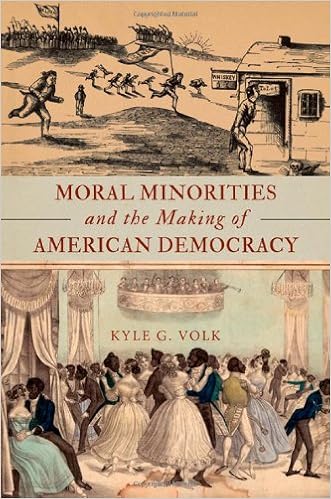
Kyle Volk, author of Moral Minorities and the Making of American Democracy (Oxford University Press) is interviewed, too.
"His book ... provides a compelling narrative of how nineteenth-century Americans negotiated the tension between majority rule and minority rights and between representative democracy and popular democracy. He focuses on debates in the antebellum northern states where moral reform efforts of Sabbatarians, temperance activist, and racial segregationists circumvented representative government to assert their social vision through direct majority rule."
HNN has posted a review of David Sehat's The Jefferson Rule: How the Founding Fathers Became Infallible and Our Politics Inflexible (Simon & Schuster).

And finally, in a piece titled, "How NASA advanced the cause of African Americans during the Civil Rights movement," Richard Paul and Steven Moss's We Could Not Fail: The First African Americans in the Space Program (University of Texas Press) is reviewed in The Washington Post.

Jumat, 24 Juli 2015

Weekend Roundup

  • From the Chronicle of Higher Education: Christopher Loss (Vanderbilt University) places our current woes in context. "[F]aculty work has always been challenging, . . . student indifference is not new, . . . business and government are necessary partners, . . . teaching and research have always existed in tension . . . ."
  • The University of Oregon's press release on Michelle McKinley's Fulbright is here
  • Lyle Denniston, for the National Constitution Center, notes Tuaua v. United States, the DC Circuit decision on American Samoa and the Insular Cases decided last month, and quotes from the historians' briefDenniston writes that Tuaua raises “a basic inquiry into what the words of the Constitution stand for . . . that probably is best resolved by the Supreme Court” and could “provide a useful examination of whether the Insular Cases have survived into the 21st Century human rights era.”  In April, we noted Professors Erman and Perl-Rosenthal's op-ed.
  • We’ve previously noted the release of more grand jury testimony in the Rosenbergs’ case.  Via HNN, here is Bruce Craig’s assessment.
    • Congratulations to legal historians who have received ACLS fellowships for 2015: Brian Cuddy, Mellon/ACLS Dissertation Completion Fellowship, for “Wider War: American Force in Vietnam, International Law, and the Transformation of Armed Conflict, 1961-1977"; Philip Thai, Luce/ACLS Postdoctoral Fellowship in China Studies, for “The War on Smuggling: Law, State Power, and Illicit Markets in Coastal China”; and Michael Willrich, ACLS Fellowship, for “The Anarchist’s Advocate: War, Terror, and the Origins of America’s Surveillance State.”  H/t: ASLH
    Weekend Roundup is a weekly feature compiled by all the Legal History bloggers.

    Space Race: The Notorious 1962 Proposal to Launch an Astronaut on a One-Way Trip to the Moon

    Mercury suborbital flights were considered a prudent first step in U.S. piloted spaceflight. The Soviet Vostok missions upstaged suborbital Mercury, leading NASA to accept more risk by moving on to Mercury orbital missions. Image credit: NASA
    When the seven Mercury astronauts were presented to the world on 9 April 1959, it was expected that, before any reached for Earth orbit, each would fly a suborbital "training" flight. These short flights, launched on modified Redstone missiles, would subject the astronauts to preflight preparations, liftoff and acceleration, a brief period of weightlessness, fiery reentry and rapid deceleration, and splashdown and recovery – in short, all of the stresses of an orbital mission. This was judged to be a prudent approach to preparing America’s astronauts for the rigors of orbital spaceflight.

    Cosmonaut Yuri Gagarin's launch into Earth orbit in the 10,420-pound Vostok 1 capsule three years later (12 April 1961) consigned this plan to the dustbin. On 5 May 1961, astronaut Alan Shepard flew a 303-mile-long, 116-mile-high suborbital hop lasting 15 minutes, 22 seconds in the 4,040-pound Mercury-Redstone 3/Freedom 7 spacecraft. The flight was widely compared with Gagarin's 108-minute single orbit and derided as proof that the Soviet Union remained far ahead of the United States in space – and that it was, perhaps, superior in other ways.

    Before a joint session of Congress on 25 May 1961, President John F. Kennedy called on NASA to land an American on the moon and return him safely to Earth before 1970. NASA tapped Apollo, previously planned as an Earth-orbital program with circumlunar potential, as its new lunar landing program. As for suborbital Mercury training flights, prudence went out the window. NASA flew only one more suborbital mission – Gus Grissom's Mercury-Redstone 4 flight (21 July 1961), which ended with the loss of the Liberty Bell 7 spacecraft during recovery – before terminating Mercury-Redstone to concentrate on Mercury-Atlas orbital flights. Two weeks after Grissom's 15-minute, 37-second flight, Gherman Titov orbited the Earth 17.5 times in 25 hours on board (6-7 August 1961), adding to feelings of humiliation and desperation in the United States.

    By the time John Glenn became the first American in orbit (20 February 1962), NASA and several advisory committees were debating how the U.S. should reach for the moon. At the same time, the U.S. civilian space agency began planning a program to bridge the gap between Mercury and Apollo. On 7 December 1961, NASA announced plans for a two-man "Mercury Mark II" spacecraft that would surpass Vostok's achievements beginning in 1963 and 1964. In January 1962, Mercury Mark II was renamed Gemini. The Gemini missions would expose astronauts to space conditions for up to two weeks (roughly the duration of a lunar mission) and give them spacewalk and orbital maneuvering practice.

    Many feared, however, that Gemini, like Mercury, would be upstaged. Though the Soviets remained cagey about their space plans, it was widely assumed that their apparent lead in powerful booster rockets would permit them to launch a man to the moon and return him to Earth in about 1965.

    Against this backdrop, John M. Cord, a Project Engineer in the Advanced Design Division at Bell Aerosystems Company, and Leonard M. Seale, a psychologist in charge of Bell's Human Factors Division, developed a plan for a desperate mission to put a man on the moon ahead of the Soviets. They unveiled their "One-Way Manned Space Mission" proposal in Los Angeles at the Institute of Aerospace Sciences (IAS) meeting in July 1962.

    Cord and Seale explained that, since neither propellants for departing the moon nor parachutes and an Earth-atmosphere-reentry heat shield would be required, their new approach would slash lunar spacecraft mass. This would enable a rocket with between 450,000 and 1.1 million pounds of thrust - perhaps a near-relative of the Saturn I rocket, a Saturn I with an advanced upper stage, or a Titan missile derivative - to launch a one-man moon lander on a Direct-Ascent path to the moon. Such a rocket would, they estimated, be ready in the United States in 1964 or early 1965.

    The Saturn I rocket was mainly a test vehicle for Saturn IB and Saturn V systems. Rockets only a little more powerful might have launched the One-Way Space Man cargo capsules and crew capsule during 1964. Image credit: NASA
    Though they termed it "one-way," Cord and Seale did not propose a suicide mission. They estimated that a rocket capable of launching a three-man Direct-Ascent Apollo mission to retrieve the One-Way Space Man – that is, a rocket with between 1.1 million and 3.5 million pounds of thrust at liftoff – would become available in the U.S. in the 1965-to-1967 period, between 18 and 24 months after his arrival on the moon. Nevertheless, the mission would be "extremely hazardous." This was due to the fact that, after its boost phase – the period between Earth liftoff and injection onto an Earth-moon path – the astronaut would be unable to abort if some technical malfunction or unknown environmental danger threatened his life. If, on the other hand, the mission were a success, it would be "significant both scientifically and politically."

    Cord and Seale viewed their mission as part of a series of increasingly capable lunar missions. First would come automated lunar flyby and orbiter missions to assess radiation hazards and photograph the moon for terrain assessment. Automated Ranger spacecraft would then photograph selected small areas up close as they plummeted toward destructive impact. A slightly different Ranger design would hard-land sturdy instruments, such as seismometers, on the moon.

    Next, automated Surveyor soft landers would visit potential One-Way Space Man landing sites to return images and perform soil experiments so scientists could determine whether the One-Way Space Man would be able to land safely. Automated rovers would follow to gather detailed data on the One-Way Space Man landing site. A rover would also place a radio homing beacon at the site to guide the One-Way Space Man's crew lander and cargo landers to safe landings.

    The One-Way Space Man mission would come next, then round-trip Apollo missions would begin. The first Apollo would, of course, set down near the One-Way Space Man's lunar base; one of the One-Way Space Man's tasks would be to select a safe site for the three-man Direct-Ascent Apollo lander that would take him home. The Apollo Program might then lead to a permanent lunar base – a goal made more attainable, Cord and Seale argued, by the One-Way Space Man's experiences on the moon.

    While the flybys, orbiters, hard and soft landers, and rovers explored the moon, engineers would develop One-Way Space Man hardware. In addition to a suitable man-rated booster rocket, they would develop a "minimum" crew capsule, a cargo capsule, a retro stage with extendible "alighting gear" for soft-landing both capsule types, and a layout for the One-Way Space Man's lunar base.

    Testing would then begin. This would include Earth-orbital crew capsule tests bearing primates, much like those conducted ahead of the Mercury-Redstone and Mercury-Atlas manned flights. A boilerplate cargo lander fitted out with engineering sensors and telemetry transmitters would land on the moon, then four cargo landers would home in on the rover-emplaced homing beacon at the One-Way Space Man landing site. The four cargo flights would test systems common to the crew lander and would pre-land supplies and equipment the One-Way Space Man would use to build his base. Finally, the One-Way Space Man would depart Earth for the moon.

    The One-Way Space Man crew capsule. Image credit: Bell Aerosystems
    Cord and Seale’s crew capsule would measure 10 feet across its base and about seven feet tall. It would provide 345 cubic feet of living volume for the One-Way Space Man. The capsule would have an empty mass of just 1735 pounds – less than half that of Mercury – and a fully loaded mass of only 2190 pounds. Its low mass was in large part attributable to its lack of an integral Earth-reentry heatshield – the heatshield would be discarded at the end of the boost phase along with other launch-abort systems. In addition to the 180-pound astronaut, the capsule would carry food and water for 12 days (90 pounds), breathing oxygen for 12 days plus an 18-day emergency supply (60 pounds), a space suit with rechargeable life-support backpack (90 pounds), tools and supplies (25 pounds), and health, first-aid, and safety gear (10 pounds).

    The thin-skinned crew capsule would not provide adequate radiation protection during the One-Way Space Man's 2.5-day Earth-moon journey nor while he lived in it while setting up his lunar base. This was because providing adequate shielding would add so much mass to the capsule that it would scuttle the entire One-Way Space Man plan. Cord and Seale noted that the next period of high solar flare activity would not begin until 1967, by which time, if all went well, the One-Way Space Man would have returned to Earth; they admitted, however, that more than 25 flares had occurred during the three years prior to their Los Angeles talk.

    One-Way Space Man lunar base. The nuclear reactor providing electricity to the base is located at the far left edge of the image; overhead cables link it to One-Way Space Man's shelter. A large dish antenna on the shelter links the One-Way Space Man to Earth. Image credit: Bell Aerosystems
    Immediately upon landing, the One-Way Space Man would set to work establishing his base. His would be a race against time; in addition to the constant threat of a solar flare, his crew capsule's fuel cells could provide electricity for no more than 9.5 days by the time he landed.

    The One-Way Space Man would exit his crew capsule through one of two hatches. The capsule would include no airlock; to exit or enter, the astronaut would need to depressurize or repressurize the entire capsule. The capsule atmosphere would consist of pure oxygen at a pressure of seven pounds per square inch.

    The environment into which the One-Way Space Man would step would be extremely hazardous, Cord and Seale warned. In fact, they forecast lunar surface conditions far more harsh than actually exist. They expected that the One-Way Space Man would find few level places and many sharp rocks. The irregular surface and knife-like rock shards would be especially hazardous during the One-Way Space Man's clumsy first days on the moon, when he would be unaccustomed to the low gravity (17% of Earth’s), harsh sunlight (almost twice as bright as on Earth), and deep shadows of the lunar surface.

    Micrometeorite dust would cover portions of the surface to a depth of about a yard, Cord and Seale reported. The One-Way Space Man would stir up the dust with his feet as he moved. They told their audience that each disturbed dust grain would ricochet off the surface and stir up additional grains. Combined with dust kicked up by micrometeorite impacts, the astronaut would walk in a veritable dust storm that would at times obscure vision. Inevitably he would carry dust into his shelter; Cord and Seale anticipated that this would place strain on the air filtering system and might damage other systems.

    One-Way Space Man space suit. Cord and Seale envisioned a harsh, dusty lunar surface covered with sharp rocks, but this image displays a benign surface. Image credit: Bell Aerosystems
    Cord and Seale attempted to estimate how often the One-Way Space Man's space suit would be penetrated by micrometeorites. These would, they reported, travel at an average velocity of 40 kilometers per second. They found that a pressure suit made of sewn three-ply nylon would experience on average 1.3 punctures every four hours. Adding a suit-sealant layer would reduce the decompression danger, but would do nothing to protect the One-Way Space Man's body from the bullet-like impacts of the micrometeorites.

    Adding a one-tenth-centimeter-thick woven aluminum layer would slash the average number of punctures to 0.007 per four-hour moonwalk and would attenuate impacts. It would, however, hamper movement. Cord and Seale recommended that the One-Way Space Man be fitted instead with a rigid aluminum suit with the joint flexibility of a nylon soft suit that would permit only 0.002 penetrations per four-hour moonwalk.

    During his first 9.5 days on the moon, the One-Way Space Man would unload the four cargo capsules, each of which would measure 10 feet wide and about 13 feet long. Each 2,190-pound cargo capsule would carry 910 pounds of supplies and equipment. Two capsules, equipped with a floor, pre-installed life support systems, and start-up supplies, would become his shelter. He would tip each onto its side, placing its floor parallel with the lunar surface, and remove its conical nosecone. He would then winch the two capsules together, forming a living space about 25 feet long.

    One-Way Space Man cargo capsule.
    Image credit: Bell Aerosystems
    If left unprotected, the One-Way Space Man's shelter would suffer on average 1.4 micrometeorite punctures per year. Cord and Seale noted that burying the shelter under "lunar rubble" would provide protection from micrometeorites and reduce its interior radiation level. Moving enough surface material to adequately bury the 25-foot-long, 10-foot-tall shelter would, however, be beyond the capabilities of a lone astronaut, so they suggested instead that the One-Way Space Man ward off meteorites by installing on his shelter's hull thin metal micrometeorite shields carried inside one of the cargo capsules. The shields, which would stand several inches off the hull, would break up and vaporize micrometeorites that struck them, blunting their impact on the shelter's hull.

    For radiation protection, Cord and Seale proposed a separate small radiation shelter that could be easily buried or moved to a “void” in a crater wall. They assumed that six feet of lunar rubble would be sufficient to protect the One-Way Space Man from solar flares. When detectors registered a sharp increase in radiation at the base site, the One-Way Space Man would hurry to the radiation shelter to wait out the flare. As his range of operations increased, he would establish other small shelters at strategic locations around his base site.

    The One-Way Space Man would bring along his own potentially hazardous radiation source: a nuclear reactor for generating electrical power. Unlike solar cells, the reactor could make electricity during the frigid two-week lunar night and, unlike fuel cells, it would not require expendables. The astronaut would move the reactor from one of the cargo landers to a small crater and, after running overhead cables back to the shelter and activating it, bury it to protect himself from its ionizing radiation.

    One-Way Space Man shelter (foreground); in the background, the buried radiation shelter (left)
    and an abandoned cargo capsule descent stage and nosecone are visible. Image credit: Bell Aerosystems
    Cord and Seale estimated that 13 cargo landers per year would be required to deliver life support supplies. Three more cargo landers would deliver parts for a multi-purpose rover and construction equipment, and one would deliver the nuclear reactor and radio equipment, including a large dish-shaped high-gain antenna. Three more would deliver "utility" payloads; these would include scientific gear. Establishing the shelter would need two cargo landers. In all, the One-Way Space Man would need 22 cargo landers during his first year on the moon.

    In addition, he might occasionally need emergency supplies, such as medicines, at short notice. Cord and Seale suggested that a small booster with a special rough-landing cargo lander – perhaps derived from Ranger – be kept on standby.

    On 11 July 1962, a few weeks after Cord and Seale presented their paper, NASA announced that it had selected the Lunar Orbit Rendezvous (LOR) mode for Apollo lunar missions, not Direct-Ascent. LOR would see an Apollo mothership with a lone astronaut on board remain in lunar orbit while two astronauts descended to the surface in a minimal "bug" lander. The bug became known first as the Lunar Excursion Module and later as the Lunar Module (LM). As already noted, Cord and Seale based the One-Way Space Man plan on the Direct-Ascent mode. They conceded that it could also include Earth-Orbit Rendezvous, another Apollo mode contender. They argued, however, that any form of rendezvous would complicate their mission plan unnecessarily.

    Although never seriously considered, Cord and Seale's proposal excited considerable interest. For example, it led off a 25 June 1962 news story on the Los Angeles IAS meeting in the pages of Missiles and Rockets magazine. Its headline read, "One-Man, One-Way Moon Trip Urged." Cord and Seale, perhaps feeling the heat for proposing such a risky mission, took exception to the word "urged" - in a letter printed in the 30 July 1962 issue of the magazine under the title "Morality and the Moon," they called their proposal "inconsistent with our moral values" as a nation. That did not stop them, however, from publishing a summary of their proposal in the publication Aerospace Engineering in December 1962. After that, technical discussion of the One-Way Space Man concept ended.

    The concept remained intriguing to many, however. In 1964, novelist Hank Searls published a thriller called The Pilgrim Project based on Cord and Seale's plan. The novel had the flavor of alternate history even as it saw print.

    In Searls' novel, the U.S. has fallen far behind the Soviet Union in the race to the moon. The Soviets have built an Earth-orbiting shipyard and have begun manned circumlunar flights while the U.S. struggles in Earth orbit to perfect rendezvous and docking using Apollo spacecraft. Searls implies that more Mercury orbital flights took place than in our timeline. but his book makes scant mention of Gemini, the program NASA used to develop rendezvous techniques.

    The lone Project Pilgrim astronaut leaves for the moon in a modified Mercury capsule soon after the Soviets have launched a three-man one-way mission. His target is a pre-landed shelter called Chuckwagon. The radio homing beacon on the shelter fails, forcing the Pilgrim astronaut to rely on visual sighting to find it on the lunar surface. Unlike Cord and Seale's One-Way Space Man, Searl's Pilgrim astronaut could swing around the moon and return to Earth if Chuckwagon or his capsule suffered a malfunction.

    The cover art for this edition of The Pilgrim Project is mostly stylized, but the Mercury-derived piloted lunar spacecraft is discernible (lower right). Image credit: McGraw Hill Book Company
    The Pilgrim astronaut spots an object on the lunar surface near Chuckwagon's expected position, so he ejects his heat shield and Earth-landing systems to reduce his spacecraft's mass for the retro maneuever. He lands successfully, exits the Mercury capsule, and moves cautiously over the stark alien surface toward the object he spotted from space. It turns out to be the Soviet lander, which has crashed in a crevasse, killing its occupants. One cosmonaut hangs out of the spacecraft hatch gripping a Soviet hammer-and-sickle flag; the Pilgrim astronaut places it with the Stars-and-Stripes in one of his suit pockets.

    The modified Mercury is not designed to serve as a temporary shelter and the Pilgrim astronaut has only a limited supply of oxygen in his suit backpack. Having no idea where Chuckwagon is, he sets out at random after laying out the Soviet and American flags side by side. His unexpected exertions as he moves over the rugged surface soon cause him to overheat. Then, just as he is about to accept his fate, he notices a slowly blinking star on the horizon; it is the flashing locator beacon on top of Chuckwagon. The novel ends as the Pilgrim astronaut sets out toward his refuge.

    Searls' novel became the basis for the 1968 Robert Altman film Countdown. In the film, a Gemini capsule on an Apollo LM descent stage replaces the modified Mercury. The story is simplified, but closely follows the novel. According to space historian and NASA biomedical researcher John B. Charles, Altman filmed the launch of Gemini 11 (12-15 September 1966), the penultimate Gemini mission, so that it could represent the launch of the Pilgrim astronaut. A Gemini-Titan rocket was, of course, not powerful enough to put a Gemini and LM descent stage on a Direct-Ascent path to the moon. The Gemini 11 scenes do, however, constitute rare cinema-quality footage of a Gemini launch.

    By the end of the Gemini program in November 1966, the U.S. was well ahead of the Soviet Union in the race to the moon. For a time it appeared that the Apollo 1 fire (27 January 1967) might set back the U.S. space program and reignite the moon race; however, the Soviet space program suffered the Soyuz 1 disaster three months later (23-24 April 1967). The closest NASA came to a desperation mission in the moon race was Apollo 8, which orbited the moon 10 times on Christmas Eve 1968. The mission, intended originally to test the LM in high Earth orbit, was dispatched to the moon without an LM to head off the threat to hard-won U.S. prestige of a possible Soviet manned circumlunar flight.

    At the end of their IAS paper and their Aerospace Engineering article, Cord and Seale explained that the One-Way Space Man concept could be applied throughout the Solar System. When next the concept of a one-way manned space mission was proposed, it was aimed at Mars, and it was envisioned as a truly one-way mission.

    At the Case for Mars VI conference in July 1996, George William Herbert of Retro Aerospace proposed that middle-aged scientists be dispatched on a one-way journey to the Red Planet to cut costs and increase scientific payback. His scenario had the scientists living out their natural lives while exploring the planet to which they had dedicated their careers. Herbert's was a new kind of desperation mission. He and his fellow Mars enthusiasts were not desperate to beat another country to Mars; rather, they were impatient to see humans on Mars.

    The one-way Mars concept remains of interest to some, though it has not earned widespread acceptance. In 2009, Lawrence Krauss, Director of the Origins Initiative at Arizona State University, told The New York Times that "To boldly go where no one has gone before does not require coming home again." He explained that a one-way approach would reduce the cost of piloted Mars exploration and compared the journey to that of the Pilgrims. Science News picked up Krauss's statement, and the magazine's readers quickly reacted. One noted that the Pilgrims traveled to a place where they knew that they could survive. One-way Mars explorers would have no such assurance. Another complained that Krauss's proposal illustrated "the decline of moral reasoning."

    Sources

    "The One-Way Manned Space Mission," IAS Paper No. 62-131, John M. Cord and Leonard M. Seale; paper presented at the Institute of Aerospace Sciences National Summer Meeting held in Los Angeles, California, 19-22 June 1962

    "At IAS meeting. . .One-Man, One-Way Moon Trip Urged," W. Wilks, Missiles and Rockets, 25 June 1962, pp. 16-17

    "Morality and the Moon," John M. Cord and Leonard M. Seale, Letters, Missiles and Rockets, 30 July 1962, p. 8

    "The One-Way Manned Space Mission," John M. Cord and Leonard M. Seale, Aerospace Engineering, December 1962, pp. 60-61, 94-102

    The Pilgrim Project, Hank Searles, McGraw-Hill Book Company, 1964

    Countdown, directed by Robert Altman, screenplay by Loring Mandel, Warner Bros. Pictures, 1968

    "One-Way to Mars," George William Herbert, AAS-96-322, The Case for Mars VI: Making Mars an Affordable Destination, Kelly R. McMillen, editor; proceedings of the sixth Case for Mars Conference held at the University of Colorado at Boulder, 17-20 July 1996

    "Science Observation," Lawrence M. Krauss, Science News, 20 October 2009, p. 4

    "Feedback – One-way ticket to Mars," Science News, 21 November 2009, p. 29