Rabu, 30 September 2015

Welcome, Samantha Barbas!

Samantha Barbas (credit)
We are delighted to have with us as a guest blogger this month Samantha Barbas, Associate Professor of Law at SUNY Buffalo Law School. Professor Barbas holds a Ph.D. in American history from the University of California, Berkeley, and a J.D. from Stanford Law School. She was previously an assistant professor of history at Chapman University, a visiting professor of history at U.C. Berkeley, and a lecturer at Arizona State University. She clerked for Judge Richard Clifton on the Ninth Circuit Court of Appeals in Honolulu, Hawaii.  She is the author of two previous books: Movie Crazy: Fans, Stars, and the Cult of Celebrity (2001) and The First Lady of Hollywood: A Biography of Louella Parsons (2005).

She is also the author of Laws of Image: Privacy and Publicity in America, which is just out from the Stanford University Press.
Americans have long been obsessed with their images—their looks, public personas, and the impressions they make. This preoccupation has left its mark on the law. The twentieth century saw the creation of laws that protect your right to control your public image, to defend your image, and to feel good about your image and public presentation of self. These include the legal actions against invasion of privacy, libel, and intentional infliction of emotional distress. With these laws came the phenomenon of "personal image litigation"—individuals suing to vindicate their image rights.

Laws of Image tells the story of how Americans came to use the law to protect and manage their images, feelings, and reputations. In this social, cultural, and legal history, Samantha Barbas ties the development of personal image law to the self-consciousness and image-consciousness that has become endemic in our media-saturated culture of celebrity and consumerism, where people see their identities as intertwined with their public images. The laws of image are the expression of a people who have become so publicity-conscious and self-focused that they believe they have a right to control their images—to manage and spin them like actors, politicians, and rock stars.
Endorsements from Lawrence Lessig, Hendrik Hartog, and Stuart Banner appear after the jump.  Welcome, Samantha!

Read more »

Jewish Legal Theorists in the 19th and 20th Centuries

[Via H-Law we have the following announcement.]
The Simon Dubnow Institute for Jewish History and Culture at Leipzig University is planning a new research group centered on the biographies and life work of nineteenth and twentieth century Jewish legal theorists. Within the research group's framework, the Institute will sponsor three closely aligned, interdisciplinary studies of individual jurists. We welcome project proposals from interested scholars.
The biographies are meant to address problems of cultural and legal history and be oriented towards the chronology of each jurist's œuvre. The projects should place special emphasis on the interaction between law and experience, with both dimensions explored through a juxtaposition of the biographies and work of – prominent and still hardly known – legal theorists. Of special interest here are the influences of political and historical constellations, social and life experiences, and religious background on a jurist's particular legal understanding. Importantly, we discourage approaches meant to demonstrate simple causalities between work and events; rather, we invite approaches grounded in both a careful distinction and simultaneous connection between origins, biography, and conceptual development.
We encourage inquiries oriented toward a complex of shared biographical, professional, and theoretical features: Were there, for example, legal areas for which the Jewish jurists felt special affinity? Can we identify legal tendencies of a theoretical-philosophical nature that were perceived as particularly compelling? In what ways did the Jewish legal theorists stamp the development of relevant schools and juridical realms? Did specifically Jewish experiences contribute to the formation of particular legal concepts? And crucially, to what extent did legal concepts and styles change with transformations in the historical, political, social, and cultural environment?
Our research group wishes to explore such questions against the backdrop of various breaks that were decisive for nineteenth and twentieth century general history and Jewish history in particular. These include the emergence of ethnically homogenizing nation states from the bankrupt old empires after World War I, the transfer of power to Hitler, the beginning of the postwar period, and the movements of migration and flight catalyzed by these developments.
In the framework of a project workshop, there will be a possibility of presenting selected project outlines in the first quarter of 2016.
We invite interested scholars to submit supporting documents, including a vita and a three-page project outline, to:
Simon Dubnow Institute for Jewish History and Culture
at Leipzig University
Professor Dr. Raphael Gross
Goldschmidtstraße 28
04103 Leipzig
or per email to Dr. Jan Gerber (gerber@dubnow.de)
Application deadline: 1 November 2015
The Simon Dubnow Institute places special emphasis on equal opportunity in hiring and research support; applications from qualified women are thus particularly welcome.
Contact Info: 
Simon Dubnow Institute for Jewish History and Culture
at Leipzig University
Professor Dr. Raphael Gross/Dr. Jan Gerber
Goldschmidtstraße 28
04103 Leipzig
Contact Email: gamke@dubnow.de

Stephens on Maori Constitutionalism

Māmari Stephens, Victoria University of Wellington, has posted “To Work Out Their Own Salvation”: Māori Constitutionalism and the Quest for Welfare, which appeared in the Victoria University Wellington Law Review 46 (2015):1-30:
New Zealand recently celebrated 75 years of the implementation of the welfare state in 1938. While debate continues about the nature and effectiveness of state welfare provision, welfare is arguably a matter of constitutional concern in New Zealand. Further examination of New Zealand legal history also shows that the welfare of Māori is indeed a matter of deep constitutional concern to Māori, who have consistently sought legislative and extra-legislative ways to have public power used for broad Māori welfare concerns. It is possible to identify a kind of Māori welfare constitutionalism at work, that is arguably in tension with the thinking and practice that produced the welfare state.

Ms. Peppercorn Considers: Various Issues for the First Time Presenter

October is nearly upon us and we are all gearing up for ASLH! One of the best things about this meeting, and about the Society more generally, is it's openness to graduate students and junior scholars. In this installment of our occasional advice column, "Ms. Peppercorn Considers," our wise colleague takes up various issues for the first time presenter. 
Dear Ms. Peppercorn:

I am a first time presenter at the 2015 ASLH annual meeting, and I have a few questions about how to prepare.  After all, we’re just weeks away from the big day!  In my one previous presentation at an in-house graduate conference at my university, I started with a little introduction of myself and my topic.  Is that too frivolous for ASLH?  Furthermore, how long should I plan to speak? Should I make a powerpoint?  And most important, what should I wear?

Sincerely,

New Kid on the Block

Ms. Peppercorn's reply:
Dear NKotB:

Ms Peppercorn loves to SEE new scholars in the field making a presentation at ASLH.  It is a substantive and productive conference, and comments and questions deliver sharp-eyed critiques without the shellacking that Ms P has been distressed to see in some venues.

That said, frivolity is frowned upon, not just by your dedicated advice columnist, but by ASLH conference goers generally.  Thus Ms P recommends only the very shortest of introductions, perhaps to say that the paper you are presenting is part of your larger dissertation project.  But do NOT delay in getting to substance.  The selection process for papers and panels is competitive (unlike some other conferences which shall remain nameless) and the people who come to your panel want to here your argument and the evidence that supports it.   No dilly dallying!

One simply cannot compete with David Rabban.

In terms of a powerpoint, note that the Society has already answered this question for you: AV equipment will not be available at the 2015 conference.

Powerpoint slides, we want to add, are all too often just text that you will be saying anyway, which makes the presenter look like a business school or poli sci denizen.  Ms P counsels in the strongest terms against presentations of that ilk, even if they were allowed.

Finally, the matter of dress is one that legal historians generally do not spend much time on.  We tend to the more practical and less ostentatious side of things.  Jane Dailey and David Rabban set a high standard, to be sure, but the rest of us muddle along.  Ripped jeans might raise some eyebrows, as would shorts.  Bling of all kinds, too.

Ms P wishes NKotB the very best for this inaugural presentation among the good legal historians.  She also invites others in the field to add their mite to the discussion.
If would like to add your own words of wisdom, please do so in the comments. For other sage advice related to this topic, see Ms. Peppercorn's previous column on "How To Survive the Conference."

Selasa, 29 September 2015

Call for Applications: ABF Doctoral/Post-Doctoral Fellowships

The American Bar Foundation has issued the following call for applications:
ABF Doctoral/Post-Doctoral Fellowship Program in Law and Social Science

Purpose
The American Bar Foundation is committed to developing the next generation of scholars in the field of law and social science.  The purpose of the fellowships is to encourage original and significant research on law, the legal profession, and legal institutions.

Eligibility
For the Doctoral/Post-Doctoral Fellowships, applications are invited from outstanding students who are candidates for Ph.D. degrees in the social sciences.  Applicants must have completed all doctoral requirements except the dissertation by September 1, 2016.  Applicants who will have completed the dissertation prior to September 1, 2016 are also welcome to apply.  Doctoral and proposed research must be in the general area of sociolegal studies or in social scientific approaches to law, the legal profession, or legal institutions. The research must address significant issues in the field and show promise of a major contribution to social scientific understanding of law and legal process.  Applicants do not need to be U.S. citizens in order to apply. Minority students are especially encouraged to apply. Applicants are also eligible to apply for the American Bar Foundation and Law and Society Association’s Law and Social Science Dissertation Fellowship & Mentoring Program.

Awards
Fellows receive a stipend of $30,000 for 12 months.  Fellows also may request up to $1,500 to reimburse expenses associated with research, travel to meet with advisors, or travel to conferences at which papers are presented.  Relocation expenses up to $2,500 may be reimbursed on application.

Tenure
Fellowships are awarded for 12 months, beginning, September 1, 2016.

Conditions
Fellowships are held in residence at the American Bar Foundation.  Appointments to fellowships are full time.  Fellows are expected to participate fully in the academic life of the ABF so that they may develop close collegial ties with other scholars in residence.

Application Process
Applications must include:  (1) a dissertation abstract or proposal with an outline of the substance and methods of the research; (2) two letters of reference, one of which must be from a supervisor of the dissertation; and (3) a curriculum vitae.  In addition, at the applicant’s option, a short sample of written work may be submitted.

Applications for this fellowship must be received no later than December 15, 2015.

Please apply online. Direct all application questions or concerns to Amanda Ehrhardt, Administrative Associate for Academic Affairs and Research Administration, American Bar Foundation, , (312) 988-6517, aehrhardt@abfn.org.

New Exhibits of Georgetown Law Library Rare Books

[Via H-Law we have the following announcement.]
Georgetown Law Library Special Collections is pleased to announce two new exhibits featuring rare books from our collections. The first is our own exhibit, Magna Carta, Sir Edward Coke, and the Rule of Law at the Dawn of American Settlement. This exhibit is located in the Special Collections exhibit case outside Room 210 in the Williams Law Library. The exhibit features 5 imprints of Magna Carta cum Statutis tum antiquis tum recentibus, the leading compilation of English statutes from the reigns of Elizabeth I and James VI & I, that were annotated in law French by their owners. It also includes images from Sir Edward Coke’s personal annotated copy of Bracton, the landmark treatise of English law written shortly after the authoritative 1225 version of Magna Carta was issued by Henry III. Full text images of all of the featured books are available through DigitalGeorgetown.
The second exhibit is Age of Lawyers: The Roots of American Law in Shakespeare’s Britain at the Folger Shakespeare Library. This exhibit features our copy of Coke’s Bracton and our set of 17th century imprints of Parts 1 through 12 of Coke’s case reports, which were so highly esteemed that they quickly became known simply as The Reports; as well as many other rare books and manuscripts from the Folger’s collections. Georgetown Law Library's Curator of Legal History Collections served as the Academic Advisor for the Folger exhibit.
For further information about these two exhibits, please contact us at specl@law.georgetown.edu.

Magna Carta at Carolina Law

Judging from this post on the Faculty Lounge, Al Brophy and the folks at Carolina Law have assembled a first-rate symposium, Celebrating 800 Years of Magna Carta.

Thursday Dinner Speakers
Representative Paul Stam
Professor A.E. Dick Howard, UVA Law

Friday Panels

The Historical Magna Carta
Paul Babie, University of Adelaide
R.H. Helmholtz, University of Chicago Law School
Wilfrid Prest, University of Adelaide
Charles Donahue, Jr., Harvard Law
Suzanna Sherry, Vanderbilt Law (moderator)

The Mythic Magna Carta 
Mary Bilder, Boston College Law School
Daniel Hulseboch, NYU Law
John Orth, Carolina Law
Sally Hadden, Western Michigan University

Keynote Address: Judge Jed Rakoff, SDNY
Introduction by Judge James Wynn, U.S. Court of Appeals (Fourth Circuit)

Unfinished Business of Magna Carta 
Richard Myers, Carolina Law
Mary Ziegler, FSU
Ted Wells, Paul Weiss
Ted Shaw, Carolina Law (moderator)

Abstracts of their articles are here. The symposium will be webcasted live. More information on the symposium is available at the North Carolina Law Review's website.

Senin, 28 September 2015

Cushman on the Docket Books of the Late Hughes Court

We’ve previously noted the analysis by Barry Cushman, Notre Dame Law School, of the docket books of the US Supreme Court during the early terms of Chief Justice Charles Evans Hughes.  Professor Cushman has posted another installment: The Hughes Court Docket Books: The Late Terms, 1937-1940,” which is forthcoming in the American Journal of Legal History 55 (December 2015):
For many years, the docket books kept by a number of the justices of the Hughes Court have been held by the Office of the Curator of the Supreme Court. Yet the existence of these docket books was not widely known, and access to them was highly restricted. Recently, however, the Court adopted new guidelines designed to increase access to the docket books for researchers. This article offers the first-ever examination of the available docket book entries relevant to what scholars commonly regard as the major decisions of rendered during the late years of the Hughes Court, from the 1937 through the 1940 Terms.

The decisions examined concern the Commerce Clause, the dormant Commerce Clause, substantive due process, equal protection, the general law, antitrust, labor relations, intergovernmental tax immunities, criminal procedure, civil rights, and civil liberties. The information in the docket books sheds new light on decisions such as Erie Railroad v. Tompkins, South Carolina State Highway Department v. Barnwell Bros., Inc., Lane v. Wilson, Railroad Commission of Texas v. Pullman, and United States v. Darby Lumber Co., and helps to explain how a nine-justice Court divided evenly on one of the issues in Coleman v. Miller. The docket books often reveal the justices’ remarks at their conference deliberations over major cases, and illuminate many previously unknown changes in justices’ positions between the conference votes and their final votes on the merits.

Analysis of the voting data contained in the docket books yields some surprising results, and offers a contribution to two bodies of political science scholarship on judicial behavior: the literature on vote fluidity and unanimity norms in the Supreme Court, and the literature on the so-called “freshman effect” that some scholars have found exhibited by the Court’s newest members. In particular, the analysis documents the prominent contribution that new justices, who disdained the Court’s longstanding norm of acquiescence in the judgments of conference majorities, made to the substantial increase in the percentage of its cases that the Court decided by a divided vote. The analysis further reveals the significant part played by the last remnants of the Old Court in retarding what would become a precipitous decline in unanimity rates under Chief Justice Harlan Fiske Stone.

Gupta-Kagan on a Landmark Family Law Case

Josh Gupta-Kagan, University of South Carolina School of Law, has posted Stanley v. Illinois' Untold Story, William & Mary Bill of Rights Journal 24 (2016):
Stanley v. Illinois is one of the Supreme Court’s more curious landmark cases. The holding is well known: the Due Process Clause prohibits the state from removing children from unwed fathers simply because they are not married and requires the state to provide all parents with a hearing on their fitness. By recognizing strong due process protections for parents’ rights, Stanley reaffirmed Lochner-era cases that had been in doubt, and formed the foundation of modern constitutional family law. But Peter Stanley never raised due process arguments, so it has long been unclear how the Court reached this decision.

This Article tells Stanley’s untold story for the first time, using original research of state court and Supreme Court records. Those records show that the state was concerned about Stanley’s parental fitness, and did not remove his children simply because he was unmarried, as is frequently assumed. But the state refused to prove Stanley unfit and relied instead on his marital status to justify depriving him of custody. That choice, and Stanley’s avoidance of a due process argument, created a complicated Supreme Court decision-making environment.

This Article explores the Supreme Court’s decision-making in Stanley, and reveals new insights both about Stanley and the Court more broadly. Four justices changed their votes from conference to the final decision – an extreme amount of voting fluidity that shifted the case outcome. The justices’ varying and evolving views eventually led them to a strong due process holding, even though Stanley did not ask for one. This issue fluidity – when the Court issues a ruling based on arguments not raised by the parties – reflects a complex interaction between justices’ efforts to form a majority coalition and lawyers’ litigation choices. Finally, the justices’ papers reveal how Justice Harry Blackmun’s shift to the liberal wing of the Court – and to a staunch parents’ rights vote – began with his angst over Stanley, despite his vote for the state.
H/t: Legal Theory Blog

Bilder on Madison on the Three-Fifths Clause

We've previously noted the publication of Madison's Hand by Mary Bilder, Boston College Law School.  Now Professor Bilder has kicked off what will apparently be a series of posts by different authors on the blog We're History prompted by Professor Sean Wilentz's recent op-ed on slavery and the US Constitution.

Minggu, 27 September 2015

Mendenhall on Holmes, Emerson and Pragmatism

Allen Mendenhall, Auburn University, has posted Pragmatism on the Shoulders of Emerson: Oliver Wendell Holmes Jr.'s Jurisprudence as a Synthesis of Emerson, Peirce, James, and Dewey, which will appear in the South Carolina Review 48 (2015): 93-109:
Oliver Wendell Holmes Jr. turned forty in 1881. The publication of The Common Law that year afforded him the opportunity to express his jurisprudence to a wide audience. Over the next year, he would become a professor at Harvard Law School and then, a few months later, an associate justice of the Massachusetts Supreme Judicial Court. Emerson died in 1882, and Holmes began to articulate Emersonian pragmatism in new ways more suited for the industrial, post-Civil War environment in which transcendentalism no longer held credence. This essay examines Holmes's adaptation of Emersonian pragmatism as a synthesis of some pragmatic theories of C.S. Peirce, William James, and John Dewey.
H/t: Legal Theory Blog

Indigenous Women In Bolivia Use Ancient Knitting Skills To Weave Devices For Congenital Heart Disease

To help the growing number of children born with heart defects, indigenous Bolivian knitters are putting their age-old craft to a more modern use. The Aymara women, who have been knitting intricate and distinct hats, sweaters, and blankets for centuries, are now using their skill to produce an innovative medical product that can seal holes in a baby’s heart.

The device, called Nit-Occlud was developed by cardiologist Dr. Franz Freudenthal. After setting up a clinic in La Paz for children with heart defects, Freudenthal knew he must develop a simple, inexpensive solution to help treat more patients. The occluder, the device's more common name, looks like a top hat and can be inserted into the heart without surgery to help fix the problem.

Sunday Book Roundup

This week, H-Net posted a review of Chanelle N. Rose's The Struggle for Black Freedom in Miami: Civil Rights and America's Tourist Paradise, 1896-1968 (Louisiana State University Press).
"Rose has complicated the clichéd racial binary of activists in Miami’s long civil rights movement during the same period, 1896 to 1968. The Struggle for Black Freedom in Miami is an exceptional history in at least two respects: for bestowing on black activists the full range of political tactics, and for using Miami as a case study to demonstrate how race relations have been both supported and undermined by a tri-ethnic border city dependent upon a tourist economy. On this note, Rose’s chapters on the intersections between the black liberation struggle and the postwar Latinization of Miami will make valuable reading for any graduate seminar."
Also on the subject of civil rights is an H-Net review of Aram Goudsouzian's Down to the Crossroads: Civil Rights, Black Power, and the Meredith March against Fear (Farrar, Straus, & Giroux).

And even more civil rights history is on HNN, with a review of Kristen Green's Something Must Be Done About Prince Edward County: A Family, a Virginia Town, a Civil Rights Battle (Harper).

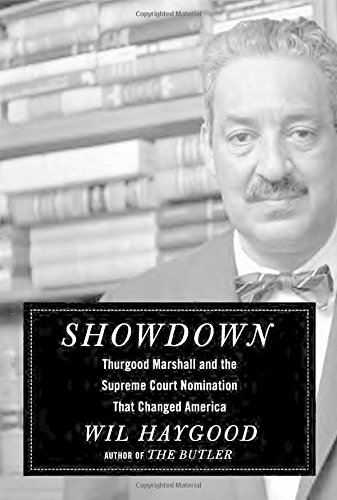
Another review of Will Haygood's Showdown: Thurgood Marshall and the Supreme Court Nomination That Changed America (Knopf) is publish in the Los Angeles Times.
"Haygood wisely avoids getting mired in legal jargon in a richly textured account that brings to life the political and cultural stakes involved in this confirmation fight. He does so by juxtaposing the drama of the Senate hearings with Marshall's travails as the NAACP's chief counselor. Stories of wrongly accused African Americans whom Marshall freed and civil rights workers whose killers he was unable to bring to justice reveal the elation and despair Marshall endured in serving as his people's go-to lawyer."
New Books in History talks with David Sehat about The Jefferson Rule: How the Founding Fathers Became Infallible and Our Politics Inflexible (Simon and Schuster).

They also interview Gregory E. O'Malley about Final Passages: The Intercolonial Slave Trade of British America, 1619-1807 (UNC Press).

Sabtu, 26 September 2015

Astronaut Sally Ride's Mission to Mars (1987)

Astronaut Dr. Sally Ride on board the Space Shuttle Orbiter Challenger during STS-7 (June 1983), her first flight into space. Image credit: NASA
Sally Ride was a member of the 1978 astronaut class, the first selected for Space Shuttle flights. During mission STS-7 (18-24 June 1983), she became the first American woman in space. Ride flew one more Shuttle mission - STS-41G (5-13 October 1984) - and served on the Rogers Commission investigating the 28 January 1986 Shuttle Challenger accident before James Fletcher, in his second stint as NASA Administrator, made her his Special Assistant for Strategic Planning on 18 August 1986. Fletcher charged Ride with drafting a new blueprint for NASA's future. She had help from a small staff, a 12-member advisory panel led by Apollo 11 astronaut Michael Collins, and a six-member space mission design team at Science Applications International Corporation (SAIC) in Schaumburg, Illinois. The result of her 11-month study was a slim report called Leadership and America's Future in Space.

On 22 July 1987, Ride testified to the U.S. House of Representatives Subcommittee on Space Science and Applications about her report. She told the Subcommittee that the "civilian space program faces a dilemma, aspiring toward the visions of the National Commission on Space, but faced with the realities of the Rogers Commission Report." The National Commission on Space (NCOS), mandated by Congress and launched by President Ronald Reagan on 29 March 1985, had been meant to blueprint NASA's future until about 2005. Headed by Thomas Paine, NASA Administrator from 1968 to 1970, it had produced instead a wide-ranging 50-year master plan for "free societies on new worlds" that would have been dismissed as unrealistic even had it not been unveiled in the chaotic aftermath of Challenger.

The Ride Report. Image credit: NASA
Whereas the NCOS report urged immediate adoption of its expansive (and expensive) "vision," Ride outlined four much more limited "Leadership Initiatives" "as a basis for discussion." In a partial break from the space station-moon-Mars progression that had dominated advanced planning since the 1950s, none of Ride's proposals necessarily followed from the others, though by Fletcher's order all would rely to some degree on NASA's low-Earth orbit (LEO) Space Station. Her piloted Mars program, for example, could proceed without her permanent piloted lunar outpost, program to study Earth from space ("Mission to Planet Earth"), or robotic Solar System exploration program ("Mission from Planet Earth").

SAIC began to design the Ride Report's piloted Mars program in January 1987. The company presented its final report to the Office of Exploration (nicknamed "Code Z" for its NASA Headquarters mail code) in November of that year. Fletcher created Code Z in June 1987 and placed Ride in charge as his Acting Assistant Administrator for Exploration. By that time, Ride had announced that she would leave NASA in August. John Aaron, who replaced her as Code Z chief, made SAIC's report the basis for Code Z's piloted Mars and Phobos mission "Case Studies" in Fiscal Year 1988.

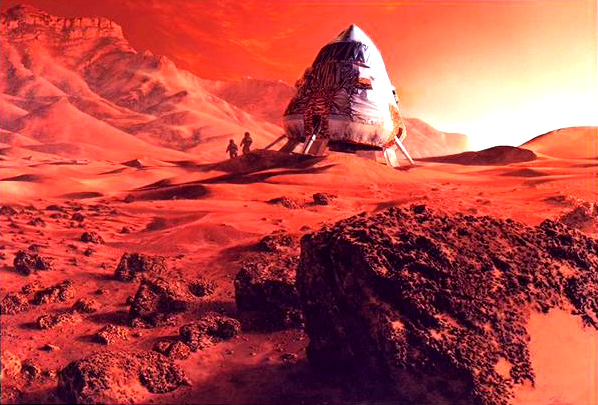
SAIC employed a split/sprint Mars mission design. The company credited a 1985 joint University of Texas/Texas A & M student design project with originating the split/sprint concept, though in fact similar concepts date back to the 1950s. The split/sprint mission would use a pair of spacecraft: an automated one-way cargo spacecraft "slowboat" launched first followed by a piloted "sprint" spacecraft. Both would burn chemical propellants and rely on aerobraking at Earth and Mars.

The cargo spacecraft would follow a propellant-saving low-energy path to Mars. It would transport to Mars orbit propellants for the piloted spacecraft's return to Earth. The piloted sprint spacecraft would leave LEO only after the cargo spacecraft was confirmed to have arrived safely in Mars orbit.

So that its six-person crew would be exposed to weightlessness, radiation, and isolation for as little time as possible, the piloted spacecraft would follow a roughly six-month path to Mars, remain at the planet for only one month, and then return to Earth in about six months. This would yield a piloted Mars mission duration of no more than 14 months.

Shuttle-derived heavy-lift launch vehicle. Image credit: M. Dowman/Eagle Engineering
In common with most other post-Challenger piloted Mars plans, the SAIC team abandoned the Space Shuttle as its primary means of launching spacecraft components and propellants to LEO. In the Shuttle's place, it proposed a heavy-lift rocket based in part on Shuttle hardware. The new rocket would debut in 1996 with a launch capability of 36 metric tons to LEO, then would evolve by 2002 to carry 91 metric tons to LEO.

Though it featured a piloted mission of short duration - which in most cases would imply expenditure of large quantities of propellants - the SAIC split/sprint mission design offered substantial propellant savings by refueling the crew spacecraft in Mars orbit. This would in turn slash the number of costly heavy-lift rockets required to launch spacecraft components and propellants to the Space Station for assembly.

A sprint-type mission using a single combined round-trip crew/cargo spacecraft would, SAIC calculated, need 25 heavy-lifters, while the split/sprint design would need only 15. In addition, because the cargo and crew spacecraft would depart Earth more than a year apart, heavy-lift launches could be spread out over a longer period, making launch vehicle, payload, and launch pad preparations less sensitive to delays due to weather constraints or malfunctions.

By the time the heavy-lifter attained its maximum capability in 2002, Phase I of SAIC's three-phase Mars program would be ended and Phase II would have just begun. Phase I, starting in 1992, would include a series of robotic precursor missions. Mars Observer, in 1987 already an approved NASA mission, would map Mars from orbit beginning in 1993; then, in 1995, Mars Observer 2 would establish and act as radio relay for a planet-wide network of hard-landed penetrator sensor stations. Orbital mapping and the seismic/meteorological net would help scientists and engineers select landing sites for automated Mars Sample Return (MSR) and piloted Mars missions.

Mars Rover Sample Return concept. Image credit: NASA
A pair of MSR spacecraft would depart Earth in 1996 to collect Mars surface samples and return them to high-Earth orbit (HEO) in 1999. A reusable Orbital Maneuvering Vehicle (OMV) based at the Space Station would retrieve the samples from HEO and deliver them for quarantine and initial study to an "isolation half-module" added to the Space Station in 1998. The samples would enable scientists to identify any hazards in Mars's surface materials and would aid engineers in the design of spacecraft, rovers, habitats, space suits, and tools.

Phase I would also include biomedical research on board the Space Station, which would reach Permanent Manned Configuration (PMC) in 1994. Almost immediately after it achieved PMC, NASA would add a Life Science Module. A six-person crew would then conduct a Mars mission simulation on board the Station that would last for the planned piloted sprint mission duration.

If the astronauts remained healthy after the simulation, then in 1996 NASA would begin development of a Mars sprint spacecraft lacking any provision for artificial gravity (that is, no part of it would rotate to create acceleration which the crew would feel as gravity). A module for housing Mars spacecraft assembly crews would join the Station in 2002, kicking off Phase II of SAIC's Mars program. The cargo spacecraft for the first split/sprint mission would depart LEO during the 2003 low-energy Earth-Mars transfer opportunity.

If, on the other hand, biomedical researchers determined that the simulation crew had suffered harm from their long sojourn in weightlessness, then NASA would add a "variable-gravity module" to the Station in 2001. Crews would conduct simulations in the spinning module to determine the minimum level of artificial gravity required to safeguard astronaut health. Development of an artificial-gravity sprint spacecraft would not commence until after the simulations ended in 2004. If the artificial-gravity sprint spacecraft needed as much development time as its no-gravity counterpart, then the first piloted Mars mission might not leave Earth until 2013. SAIC largely ignored this possibility.

SAIC's automated cargo spacecraft (right) in Earth-orbit launch configuration with large Orbital Transfer Vehicle (OTV). The conical vehicle at the center of the cargo spacecraft's dish-shaped aeroshell is the piloted Mars Lander. Spherical tanks around the Mars Lander contain Earth-return propellants for the piloted sprint spacecraft. Image credit: Science Applications International Corporation
Launching parts and propellants from Earth's surface for the 238.5-metric-ton cargo spacecraft and its single 349.6-metric-ton reusable Orbital Transfer Vehicle (OTV) would require seven heavy-lift rocket launches. The cargo spacecraft would carry at the center of its 28-meter-diameter bowl-shaped Mars Orbit Insertion (MOI) aerobrake heat shield the mission's two-stage, 60-metric-ton Mars Lander.

Spherical tanks surrounding the Lander would hold the 82.5 tons of cryogenic liquid hydrogen and liquid oxygen propellants the piloted sprint spacecraft would need for return to Earth. The cargo spacecraft would also carry 4.2 metric tons of propellants for correcting its course during flight from Earth to Mars and 16.4 metric tons of propellants for circularizing its orbit after it aerobraked in Mars's atmosphere. A 9.1-metric-ton cooling system would prevent the propellants from boiling and escaping.

On 9 June 2003, the 30.5-meter-long cargo spacecraft/OTV stack would move away from the Space Station using small thrusters. The OTV would then ignite its engines to push the cargo spacecraft out of LEO. After sending the cargo spacecraft on its way, the OTV would separate, fire its engines to slow itself, aerobrake in Earth's upper atmosphere, and return to the Station for refurbishment, refueling, and reuse.

The cargo spacecraft's course would intersect Mars on 29 December 2003. It would aerobrake in Mars's upper atmosphere to slow itself so that the planet's gravity could capture it into orbit. The cargo spacecraft would rise to its apoapsis (orbit high point), then fire its rocket engines to raise its periapsis (orbit low point) out of the martian atmosphere and circularize its orbit. Flight controllers would then begin careful checkout and monitoring of the cargo spacecraft and its cargo, paying special attention to the propellants the piloted sprint spacecraft would need for return to Earth.

Partial cutaway view of SAIC's piloted sprint Mars spacecraft. A = bowl-shaped Mars Orbit Insertion aerobrake heat shield; B = cylindrical habitat modules (2); C = cylindrical logistics module; D = cylindrical "bridge" tunnel; E = cylindrical tunnel linking docking unit (right), bridge tunnel, and Earth Recovery Vehicle; F = drum-shaped Earth Recovery Vehicle; G = flattened conical aerobrake heat shield; H = engines (2); I = spherical liquid hydrogen tank; J = spherical liquid oxygen tanks (2). Not shown: cylindrical command module, cylindrical airlock module, and one spherical liquid hydrogen tank. Image credit: Science Applications International Corporation/DSFPortree
SAIC offered a piloted spacecraft design with Station-derived pressurized crew modules connected in "race track" formation; that is, in a square with each module linked by short tunnels at or near their ends. A pair of 4.4-meter-diameter, 12.2-meter-long habitat modules, each with a mass of 15.5 metric tons, would form two sides of the square; a 4.4-meter-diameter, 12.2-meter-long, 10.8-metric-ton logistics module would form the third side; and an 8.5-metric ton command module and a 3.2-metric-ton airlock module would together make up the fourth.

A pressurized "bridge" tunnel would cross the inside of the square, linking directly the two habitat modules. Another tunnel would pierce the center of the bridge tunnel vertically. Its forward end would link with the top of the drum-shaped, 11.9-metric-ton Earth Recovery Vehicle (ERV), while its aft end would carry a docking unit. The ERV, situated deep within the spacecraft's structure, would double as the crew's solar flare "storm" shelter. Four spherical tanks holding a total of 91.9 metric tons of cryogenic liquid hydrogen/liquid oxygen propellants and two rocket engines with a combined mass of 4.6 metric tons would be mounted atop the crew modules.

The ERV/storm shelter would be mounted at the center of an 11.4-meter-diameter, one-metric-ton flattened conical aerobrake heat shield. ERV, ERV aerobrake, crew modules, tunnels, propellant tanks, and engines would nestle within a bowl-shaped, 25-meter-diameter, 16.1-metric-ton MOI aerobrake. Except during propulsive maneuvers and aerobraking, four solar arrays capable of generating a total of 35 kilowatts of electricity at the piloted spacecraft's maximum distance from the Sun (that is, in Mars orbit) would extend beyond the edge of the MOI aerobrake. During maneuvers and aerobraking, the arrays would be folded out of harm's way atop the crew modules. Fully assembled and loaded with propellants, the piloted spacecraft's mass would total 193.7 metric tons.

The assembly crew based at the Space Station would link a newly assembled smaller (197.4-metric-ton) OTV to the piloted spacecraft, then would attach the larger OTV used to launch the cargo spacecraft to the new OTV. This would create a 48-meter-long, 738.7-metric-ton Earth-departure stack.

SAIC's piloted sprint spacecraft (right) in Earth-orbit launch configuration with large and small reusable OTVs. Image credit: Science Applications International Corporation
The stack would move away from the Space Station on 21 November 2004. Shortly thereafter, the first OTV would ignite its engines to start the second OTV and the piloted sprint spacecraft on their way. Its work completed, it would then separate, aerobrake in Earth's atmosphere, and return to the Station for reuse. The second OTV would repeat this performance, then the piloted sprint spacecraft would burn nearly all of its propellants to place itself on course for Mars.

The piloted spacecraft would aerobrake in Mars's atmosphere and fire its engines to circularize its orbit on 3 June 2005. Almost immediately after MOI, the crew would rendezvous with the waiting cargo spacecraft. Three crewmembers would board the Mars Lander, deorbit, and land at the preselected landing site. They would explore the site for from 10 to 20 days.

The other three astronauts, meanwhile, would transfer the Earth-return propellants stored on board the cargo spacecraft to the piloted spacecraft's empty tanks. They would also discard the piloted spacecraft's MOI aerobrake.

SAIC noted that the ideal trajectory for a one-year piloted Mars mission launched as soon as possible after the cargo spacecraft arrived at Mars on 29 December 2003, would have the piloted spacecraft depart Earth on 8 January 2005, reach Mars on 2 August 2005, depart Mars on 1 September 2005, and return to Earth on 8 January 2006. SAIC's Earth-departure date, a little more than a month ahead of the ideal date, would increase the piloted mission’s duration by almost two months.

Launching the piloted sprint spacecraft early would, however, add an abort option to the mission. If, for example, the cargo spacecraft's propellant cooling system failed and allowed the Earth-return propellants it kept liquid to escape while the astronauts were en route to Mars, then they could use the propellants that they would have used to circularize their orbit about Mars after aerobraking to ensure that their spacecraft would skim through Mars's uppermost atmosphere on 3 July 2005. The aeromaneuver, properly executed, would nudge the piloted spacecraft's course enough that it would intersect Earth on 15 January 2006.

SAIC's Mars crew lander would reach Mars orbit 18 months ahead of its three-person crew. It would become the astronauts' base of operations during a surface stay lasting up to 20 days. Image credit: P. Hudson/NASA
SAIC explained that one goal of Phase II of the Mars program would be to seek out a site for a permanent Mars base. The company envisioned that NASA would launch a series of three split/sprint missions by the end of the first decade of the 21st century.

In fact, while the first crew explored Mars's surface and worked in orbit to prepare their spacecraft for the trip home, the cargo spacecraft for the second Mars crew would depart LEO boosted by the same large aerobraking OTV the first mission's cargo and piloted spacecraft had used. The second crew would leave Earth orbit in early 2007 and return from Mars in early 2008. The final crew in the series would depart for Mars in early 2009 and return home in early 2010.

After the third Mars expedition, establishment of the Mars base – Phase III of SAIC's program – could begin. The company provided few details of Phase III.

With their surface mission completed, the first Mars explorers would lift off in their Mars Lander's ascent stage. SAIC explained that the ascent stage would make up about half the mass of the Lander. The piloted spacecraft would rendezvous and dock with the ascent stage in Mars orbit to collect the surface crew and their Mars samples. On 2 August 2006, shortly after casting off the spent ascent stage, the astronauts would fire the piloted spacecraft's twin engines to begin a five-month return to Earth.

As Earth loomed large ahead of what remained of the sprint spacecraft, the astronauts would enter the ERV capsule with their samples and undock. The ERV, which would resemble one of the early designs for NASA's planned Space Station lifeboat, would slide out of a radiation shield housing that would remain behind on the crew spacecraft. The abandoned sprint spacecraft would then fire its engines a final time to miss Earth and enter orbit about the Sun.

SAIC based its ERV configuration on this NASA design for a Space Station lifeboat. Image credit: NASA
The ERV would aerobrake in Earth's atmosphere, then an automated OMV from the Space Station would retrieve it. After physical examinations and a period of quarantine on board the Station, the first Mars crew would return to Earth on board a Space Shuttle.

SAIC wrote that its piloted split/sprint Mars mission could open the door to international space cooperation. Other countries, both allies and rivals, could contribute money, crew members, precursor missions, services such as propellant delivery, spacecraft components, or even entire spacecraft. For all the countries involved, piloted Mars missions would "provide an effective catalyst for significant advances in automation, robotics, life sciences[,] and space technologies. . .[and], through direct experience, address and answer key questions about long-duration human space flight and the role of human beings in space exploration."

NASA did not much care for the Ride Report; in fact, the agency at first refused to publish it. Ultimately the agency printed about 2000 copies, which is an unusually small number for such a high-level report. Perhaps this was because Ride acknowledged that NASA could not hope to lead in all areas of space endeavor. In addition, Ride proposed a manned Mars program after Space Station with no intervening manned moon program, placed robotic programs on a par with their piloted counterparts, and implied that NASA might not need a new piloted space initiative after it finished building its Space Station.

Her report's matter-of-fact tone probably annoyed some within NASA. Ride, who by the time she completed her report was nearing the end of her nine-year NASA career, felt free to express herself. She was quick to point out when NASA's actions apparently belied its enthusiasm for piloted missions beyond LEO; for example, she noted the uncomfortable fact that Fletcher had committed only 0.03% of NASA's budget to funding the new Office of Exploration. This, Ride explained, gave the appearance that Code Z had been established merely to quell critics who complained that NASA had no long-term goals.

Ride worked briefly at Stanford University, her alma mater, following her departure from NASA. In 1989, she became a physics professor at the University of California-San Diego. She led space public outreach projects for NASA, co-founded the Sally Ride Science education company in 2001, participated in the Columbia Accident Investigation Board in 2003, and co-authored several science books for children. In early 2011, she was diagnosed with pancreatic cancer. She died at age 61 on 23 July 2012.

Sources

"Piloted Sprint Missions to Mars," AAS 87-202, J. Niehoff and S. Hoffman, The Case for Mars III: Strategies for Exploration - General Interest and Overview, Carol Stoker, editor, 1989, pp. 309-324; paper presented at the Case for Mars III conference in Boulder, Colorado, 18-22 July 1987

Leadership and America's Future in Space, Sally K. Ride, NASA, August 1987

Piloted Sprint Missions to Mars, Report No. SAIC-87/1908, Study No. 1-120-449-M26, Science Applications International Corporation, November 1987

Humans to Mars: Fifty Years of Mission Planning, 1950-2000, David S. F. Portree, Monographs in Aerospace History #21, NASA SP-2001-4521, NASA History Division, February 2001

Related posts

The Collins Task Force Says Aim for Mars (1987)

McDonnell Douglas Phase B Space Station (1970)

Gumdrops on Mars (1966)

A Museum of "the Weapon of the Weak"

The American Museum of Tort Law opens tomorrow in Winstead, CT, Ralph Nader's home town, the New York Times reports.  A ceremony to dedicate the museum takes place today.  Speakers include Ramsey Clark, Eric Foner (who coined the phrase in our title), and Patty Smith, whose "father, a factory worker, had worshiped Mr. Nader."

Jumat, 25 September 2015

Weekend Roundup

  • Speaking of Constitution Day lectures, the uproar over Sean Wilentz's op-ed in the New York Times on slavery and the Constitution, which appeared on the day of his Constitution Day lecture at Princeton, continues.
  • Saul Cornell, Fordham University, will speak on "The Founding Fathers and the Origins of Gun Control: The Forgotten History," at 7 p.m. on Wednesday, September 30, in the Sandra and Alan Gerry Forum, Room 010 in the Rowley Center for Science and Engineering, SUNY Orange, Middletown.  
  • University of Chicago law alumni in Washington, DC, with a spare $25 lying around can hear Laura Weinrib on Labor, Lochner and the First Amendment on Wednesday, September 30, at noon at the Willard Hotel.  Geoffrey R. Stone, Chicago's interim dean, presides.
  • Earlier this year we noted a Call for Papers on "Law Collecting and Law Collectors" from the Scottish Council of Law Reporting with the University of Edinburgh. The organizers have extended the deadline to October 31.  
  • We've heard (from a web posting to which we can no longer link) that faculty members at Brown University are organizing a legal history workshop.
  • I thought some more about my reference to the "timeliness" of Michael Widener in that post on the YLS exhibit on the Pope as judge and lawgiver and realized that my word choice might imply that it was a rush job thrown together to capitalize on the papal visit.  Of course, it was not.  Widener and Anders Winroth had thought of it before the visit was announced.  Not "timeliness," then, but good instincts and really good luck.  DRE.
Weekend Roundup is a weekly feature compiled by all the Legal History bloggers. 

    Green on Clarity and Reasonable Doubt in Judicial Review in the Early Republc

    Christopher R. Green, University of Mississippi School of Law and, this year, a fellow in the James Madison Program at Princeton University, has posted Clarity and Reasonable Doubt in Early State-Constitutional Judicial Review:
    Courts exercising judicial review in every state require the conflict between a statute and the state constitution to be “clear,” rather than simply shown by the preponderance of the evidence. In almost every state, however, courts also require proof of unconstitutionality beyond reasonable doubt. A state-by-state canvass shows that in the great majority of states, a clarity requirement appeared first, sometimes long before a no-reasonable-doubt rule. To the extent they conflict, clarity has a better pedigree, but there are compelling reasons to take early reasonable-doubt formulations as elaborations of a clarity rule, rather than a consciously higher standard.

    The judicial obligation to exercise judicial review only when a constitutional conflict is clear is coupled with an obligation to render constitutional requirements as clear as possible. This obligation means, at a minimum, responding to all contrary considerations with an adequate reasoned explanation, as in contemporary administrative law. Because clarity is contingent on the amount of analysis that courts have given a constitutional issue in response to litigation, it can change over time.

    Are historic rationales for a clarity requirement obsolete? One basic sort of rationale — the gravity of judicial review because of its resistance to correction — is not. Another sort of rationale, however — deference to the constitutional views of elected branches — is undermined if and when legislators fail to conduct constitutional analysis or executive officers fail to justify statutes adequately in litigation. Judicial consideration of such failures, however, need not eliminate a clarity requirement, which is a burden of persuasion, not production. Failures of legislative or executive justification can satisfy a clarity requirement or presumption of constitutionality rather than eliminating them.

    Kamis, 24 September 2015

    Prakash to Deliver Murphy Lecture at Princeton

    Saikrishna Bangalore Prakash, University of Virginia School of Law, delivers the Walter F. Murphy Lecture in American Constitutionalism, entitled "The Living Presidency’s Imperial Beginnings," on Monday, September 28, 2015, at 4:30 p.m. in Dodds Auditorium, Robertson Hall, Princeton University.  This public event is cosponsored by Princeton’s James Madison Program in American Ideals and Institutions, and the Program in Law and Public Affairs.

    We've previously noticed the publication of Professor Prakash's new book, Imperial from the Beginning: The Constitution of the Original Executive.

    The Collins Task Force Says Aim for Mars (1987)

    The Apollo 11 crew of Neil Armstrong (left), Michael Collins, and Edwin Aldrin. Image credit: NASA
    The January 1986 Challenger Space Shuttle accident laid bare many shortcomings of the U.S. space program. NASA, which only 14 years before had soared to the moon, had suffered chronic underfunding since the truncated Administration of President Richard Nixon (1969-1974). At the same time, expectations for the Shuttle grew, until, in January 1984, President Ronald Reagan called upon NASA to use its Shuttle fleet to build an Earth-orbiting Space Station within a decade.

    NASA had eagerly encouraged such expectations. The Shuttle, it promised, would fly cheaply and often, permitting it to replace all U.S. expendable rockets and fly commercial payloads for domestic and foreign customers. It would fly so inexpensively that Shuttle astronauts would economically service Earth-orbiting satellites. The Shuttle would reliably launch all U.S. robotic planetary missions, saving so much money that a new era of planetary exploration could begin. By conducting secret military missions - many launched from California into near-polar orbits - it would help to ensure U.S. national security. It would be safe enough that it would carry non-astronaut passengers - researchers, teachers, journalists, and others - and its crews would fly without pressure suits.

    The Space Shuttle would also open the door to new space programs. The Space Station, NASA declared, was "the next logical step" after the Shuttle. That implied other, unspecified steps after the Space Station, in the 1990s and beyond.

    Even before the Challenger accident called many of NASA's promises into question, Reagan had come under pressure to give the space agency a long-term goal that would provide a clear rationale and context for the Shuttle and Station programs. In late 1984, in fact, Congress mandated that the White House appoint an independent commission to study NASA's long-term options and offer recommendations for its future direction.

    The Space Shuttle was developed in a dangerously constrained funding environment. Despite this, NASA sought to promote a bold vision of a Shuttle-launched future. Image credit: NASA
    The National Commission on Space (NCOS) began its planned year-long study on 29 March 1985. Reagan tapped Apollo-era NASA Administrator Thomas Paine to head up the Commission. Among its commissioners were such aviation and spaceflight luminaries as first moonwalker Neil Armstrong, Chuck Yeager, the first person to fly faster than sound, and Kathryn Sullivan, the first U.S. woman to walk in space.

    The NCOS report, titled Pioneering the Space Frontier, reached the news media in March 1986. Paine formally presented it to the White House and Congress on 22 July 1986. It called for a 50-year program that included fully reusable shuttles, heavy-lift rockets, an Earth-orbiting spaceport, a variable-gravity space station for biomedical research, lunar oxygen mines, cycling Mars liners, an outpost on inner martian moon Phobos, and a science base on Mars. It touched on topics as wide-ranging as self-replicating space factories, submersibles for the hypothetical world-ocean of Uranus, and U.S. involvement in the International Space Year of 1992.

    Set against the backdrop of the Challenger accident and NASA's revealed weaknesses, the NCOS program appeared at best grandiose. The Reagan Administration quietly shelved the NCOS report.

    Concern over NASA's long-term direction had, however, not abated. If anything, it had increased, in part because the Soviet Union had launched its long-awaited Mir core space station (20 February 1986). Many feared that the U.S. civilian space agency had lost not only its sense of direction, but also its place as the world leader in spaceflight.

    On 18 August 1986, less than a month after the NCOS report reached Congress and the White House, NASA Administrator James Fletcher appointed Sally Ride, the first U.S. woman in space, as his Special Assistant for Strategic Planning. He charged her with preparing a new blueprint for NASA's future - one more focused and readily achievable than the NCOS blueprint - that would emphasize specific ways that NASA could demonstrate U.S. leadership in space.

    Robotic Mars missions would have played significant roles in both the Collins Task Force piloted Mars program and Sally Ride's robotic Solar System exploration "leadership initiative." Image credit: NASA
    While drafting her report, Ride received input in the form of a three-and-a-half-page paper from the NASA Space Goals Task Force, a 12-member group appointed by NASA Advisory Council chairman Daniel Fink and chaired by Apollo 11 Command Module Pilot Michael Collins. The Council gave the Collins Task Force final report its blessing during its 3-4 March 1987 meeting, and Fink submitted the report to Fletcher to pass on to Ride on 16 March.

    The Space Goals Task Force declared that a "bold goal, clearly stated" would help the space agency to "focus and clarify" its long-term objectives. Mars, the Task Force declared, stood out as "the one entity most likely to capture widespread enthusiasm and support, while pulling considerable scientific and technical capability in its wake." It called for a public declaration that astronauts "exploring and prospecting on Mars" would henceforth become NASA's "primary goal."

    The Task Force then outlined "preliminary steps" that the U.S. would need to take before Americans could take steps on Mars. First, the Space Shuttle would need to resume operations and new expendable rockets would need to be developed to supplement it. This would help to ensure uninterrupted U.S. space access. Funding for space technology research would need to be increased to reverse the "serious erosion of our technology base" that began during the Nixon Administration. In addition, an "aggressive" program of robotic Mars missions would be required.

    NASA would also need to complete the Space Station as soon as possible so that it could serve as a test-bed for the development of Mars Program technologies and a laboratory for studying long-duration spaceflight effects on human physiology. "The Space Station is an element of human expansion [into space] in its own right," the Task Force declared, "but it is far more important because of its essential role in building the capability to conduct programs that achieve and demonstrate [space] leadership."

    One of many piloted Mars lander designs proposed in the mid-to-late 1980s - the "molly bolt" configuration. Image credit: Eagle Engineering/NASA
    When Americans set foot on Mars, the Task Force continued, it should be as part of a "peaceful enterprise done in the name of all humankind." It asserted, in fact, that American Mars explorers should, "[u]nder appropriate conditions," be accompanied by astronauts of other "qualified nations," including the Soviet Union.

    The Task Force called for "a realistic schedule" for its Mars Program that would ensure "stable planning and execution of a studied, orderly, progressive series of events." As part of the effort to develop a schedule, NASA, the President, and the Congress would need to decide "whether the moon should be used as stepping stone to Mars, or should be bypassed."

    It concluded by considering commercial opportunities that the Mars Program might create. NASA would "pull" commercial space ventures into existence through its revitalized research programs, the Collins Task Group report argued, adding that the "history of this Nation is replete with examples of successful commercial activity stimulated by the technologies resulting from the exploration of new frontiers." "The technical challenges associated with a program of human exploration of Mars are of such a magnitude," it continued, that they would "certainly provide many direct and indirect stimuli to American industry."

    The Space Goals Task Force report influenced Sally Ride's August 1987 report Leadership and America's Future in Space, though she gave equal emphasis to four leadership initiatives (Earth studies, robotic Solar System exploration, an outpost on the moon, and humans to Mars). She believed that the U.S. could not demonstrate space leadership in all areas of spaceflight endeavor, so should choose one or two and excel in them. She also believed that NASA should return astronauts to the moon before accepting the greater challenge of astronauts on Mars.

    Coliins, probably the most articulate of the astronaut writers, subsequently sought to build support for the Mars-centered Space Goals Task Force program. In a prominent article in the November 1988 issue of the widely circulated National Geographic magazine and in his 1990 book Mission to Mars, he called upon NASA to bypass the moon and launch humans to Mars as early as 2004.

    Sources

    Letter with enclosure, Daniel J. Fink to James C. Fletcher, "NASA Space Goals Task Force Final Report," 16 March 1987

    "Mission to Mars," Michael Collins, National Geographic, Volume 174, November 1988, pp. 732-764

    Mission to Mars: An Astronaut's Vision of Our Future in Space, Michael Collins, Grove Press, 1990

    Humans to Mars: Fifty Years of Mission Planning, 1950-2000, David S. F. Portree, Monographs in Aerospace History #21, NASA SP-2001-4521, February 2001, pp. 68-69

    Related Posts

    Sally Ride's Mission to Mars (1987)

    Evolution vs. Revolution: The 1970s Battle for NASA's Future

    What Shuttle Should Have Been: NASA's October 1977 Space Shuttle Flight Manifest

    Where to Launch and Land the Space Shuttle? (1971-1972)

    Rabu, 23 September 2015

    Legal Life Writing: Workshop and Book Launch

    [We have the following announcement.]

    The Legal Biography Project at the LSE
    Legal Life Writing: Marginalised Subjects and Sources -
    A Workshop and Book Launch

    Tuesday 20 October 201
    5 | 4-6pm Moot Court Room, 7th Floor, New Academic Building, London School of Economics (LSE), 54 Lincoln's Inn Fields, London WC2A 3LJ. Followed by Drinks Reception: 6-7pm.

    ‘Life writing' is an increasingly popular field of scholarship but much work to date has focused on charting the lives of the elite; most often white male judges and lawyers. Scholarship in this field has also been limited in its inter-disciplinary scope. This workshop will discuss a new book, Legal Life Writing: Marginalised Subjects and Sources (Wiley, 2015), edited by Linda Mulcahy (LSE) and David Sugarman (Lancaster) that explores the gaps in existing literature by focussing on the lives of those usually marginalised or treated as outsiders. It also endeavours to expand the range of sources it is considered legitimate to use when researching legal lives. The collection aims to ignite debate about the nature of the relationship between socio-legal studies and legal history; explore how gaps in the existing literature can be filled when sources about the marginalised are often scant; and challenge the methodologies employed in conventional accounts of legal lives.

    David Sugarman
    's scene-setting essay analyses ways in which legal life writing has been enlarged to embrace a wide range of subjects, sources and methods. This chapter, and the collection as a whole, advances a broader, more pluralistic, democratic conception of legal life writing that encourages inter-disciplinary dialogue, helping legal historians, historians and socio-legal scholars to develop new skills and embrace a wider range of participants and audiences, thereby enhancing their ability to engage with public issues in public history. Specific articles in the collection complement these general discussions by providing detailed accounts of particular actors whose stories have remained largely untold. Fiona Cownie discusses Clare Palley, the first woman professor of law at a United Kingdom University, and, playing with the notion of outsider-insider, Catharine MacMillan examines the life of the outwardly successful Jewish-born lawyer, Judah Benjamin. Several essays explore the alternative sources that can be turned to in order to fill gaps in existing knowledge. Rosemary Auchmuty focuses on the sources one might use to explore the lives of women in law. 

    Other essays address the use of visual sources. Leslie Moran examines the use of images of judges, and their capacity to illustrate how authority is performed. Linda Mulcahy's study of the trial spectator utilises images of trials in popular journals and fine art which indicate how women participated in the public sphere of the courts.  The focus on gaps in the existing literature has also been extended in this book to cover other academics who have been much written about from a particular's perspective in ways which have obscured their broader contribution to law and the public sphere. Thus, Mara Malagodi considers the life of Ivor Jennings, one of Britain's most prominent constitutional law scholars of the twentieth-century. Malagodi contends that his oft-neglected work in South Asia during the early years of the Cold War allows us to see the man and his work through a very different lens.

    Presentations about the book will be led by Professor Nicola Lacey (LSE) and Professor Michael Lobban (LSE) and chaired by Professor Phil Thomas (Journal of Law and Society).

    For further details of the LSE Legal Biography Project see [here]

    Lieblich on "Internal Jus Ad Bellum"

    Eliav Lieblich, Radzyner School of Law, Interdisciplinary Center, has posted Internal Jus Ad Bellum, which is forthcoming in the Hastings Law Journal 67 (2016).
    In 1945, the U.N. Charter famously set out “to save succeeding generations from the scourge of war.” Having in mind traditional interstate wars, the Charter’s Article 2(4) outlawed, for the first time, interstate uses of force. However, nowadays, international wars are relatively rare, while civil wars are both more numerous and increasingly destructive. Still, international law has yet to develop a regime regulating the resort to war (jus ad bellum) within a state, either by governments or opposition groups. Contemporary jus ad bellum, thus, fails to address one of the most atrocious forms of war in the modern international system.

    This Article puts forward a novel theory of internal jus ad bellum, equally applicable to governments as well as opposition groups. It demonstrates that the current blind-spot in international law concerning this issue is incoherent and unwarranted. By applying the revisionist approach to just war theory, this Article argues that internal resort to armed force can only be morally acceptable if undertaken in self (or other) defense against grave threats.

    Applying this notion to the international-legal sphere, this Article claims that collectivist doctrines such self-determination, sovereignty or democratic entitlement are not appropriate venues for an acceptable standard of internal jus ad bellum. It proceeds to locate such a possible standard in international human rights law (IHRL), which enshrines everyone’s right to life. However, as the Article demonstrates, IHRL, as currently understood, fails to serve as an effective framework for internal jus ad bellum, since it collapses, during armed conflict, into international humanitarian law (IHL). The Article concludes by suggesting an understanding of IHRL that can overcome these limitations and thus serve as a working doctrine of internal jus ad bellum.

    Funk Reviews Compton's "Evangelical Origins of the Living Constitution"

    Kellen R. Funk, a Yale JD and a doctoral candidate in history at Princeton University, has posted Shall These Bones Live? Property, Pluralism, and the Constitution of Evangelical Reform, which is forthcoming in Law and Social Inquiry.  It is a review essay based on John W. Compton’s The Evangelical Origins of the Living Constitution (2014).
    The Supreme Court of the New Deal era transformed the American Constitution, making the Constitution’s original protection of property rights give way to democratically popular regulations. In The Evangelical Origins of the Living Constitution (2014), John W. Compton argues that twentieth-century progressives turned the Court towards a “living” interpretation of the Constitution by relying on legislative methods and judicial precedents created by nineteenth-century evangelicals. Evangelical reformers accomplished national prohibition of liquor and lotteries, but their regulations destroyed property rights that were legally valid and socially acceptable at the inauguration of the Constitution. Courts ultimately acquiesced in novel economic proscriptions because of overwhelming majoritarian sentiment driven by evangelical populism. Relying on a recent literature of law and religion, Compton challenges conventional accounts of America’s constitutional tradition of protecting property. This essay reverses the path of analysis and argues that evangelical concerns about the Constitution’s property clauses can alter standard accounts of law and religion in American history. Rather than a simplistic imposition of moralism, evangelical reform — like that of contemporaneous progressives and their descendants — sought to protect liberalism with regulations rooted in antislavery thought.